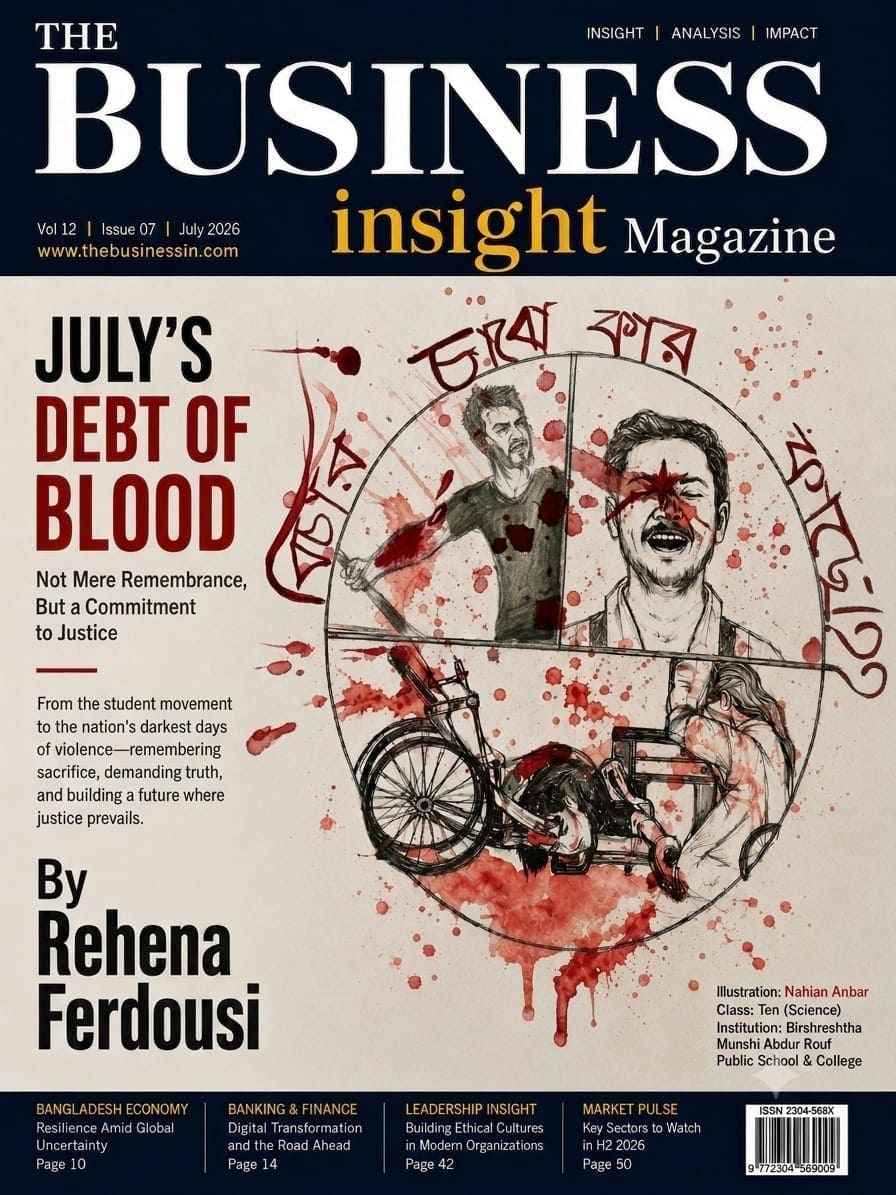
By Rehana Ferdouse
The full moon of Ashar, the Bengali monsoon month, brings a unique beauty to the landscape of Bengal every year. Yet after the bloodstained events of July 2024, that moonlight has come to represent more than beauty for many Bangladeshis. It evokes memory, grief, pain and sacrifice. Its serene glow reminds us of families who lost beloved children, relatives, colleagues and fellow citizens. Time moves forward, but some moments never disappear from a nation’s memory. July 2024 is one such chapter—deeply etched in the political, social and humanitarian history of Bangladesh.

Throughout Bangladesh’s history, students and young people have repeatedly stood at the forefront of change. From the Language Movement of 1952 to the Mass Uprising of 1969 and the struggle for independence, they have played a defining role in shaping the nation’s destiny.
The movement that emerged in mid-June 2024 following a judicial decision related to quotas in public employment was initially centred on demands for fairness, equality and merit-based recruitment. As protests spread across universities and educational institutions, however, tensions escalated rapidly. Demonstrations, counter-programmes, operations by law enforcement agencies, curfews and restrictions on internet and mobile communications turned the situation into a profound national crisis.
In a democratic state, peaceful expression and protest are fundamental rights. At the same time, the state bears the responsibility of maintaining law and order and protecting citizens. When this balance collapses, ordinary people pay the highest price.
From mid-July into the first half of August, Bangladesh witnessed devastating violence and loss of life. Students, ordinary citizens, pedestrians, children, journalists and members of law enforcement agencies were among those killed or injured. Thousands suffered wounds, and many were left with permanent disabilities, including loss of eyesight.
The death of a child is never merely a statistic. It is the loss of a family’s future, a mother’s dream, a father’s hope and a nation’s potential. Likewise, a police officer who loses his life is also a cherished member of a family. Every life lost deserves human dignity and compassion. No citizen’s life should be valued differently because of political identity.
But equal human dignity does not mean that questions of responsibility can be blurred. Determining who exercised power, who ordered or carried out unlawful violence, and who committed retaliatory attacks is essential to truth and justice.
The events of July and August drew intense international concern. In its fact-finding report published on 12 February 2025, the Office of the United Nations High Commissioner for Human Rights concluded that Bangladesh’s former government, security and intelligence services, along with violent elements associated with the Awami League, had systematically committed serious human rights violations during the student-led protests.
The UN Human Rights Office said there were reasonable grounds to believe that hundreds of extrajudicial killings, widespread arbitrary arrests and detention, and acts of torture were carried out with the knowledge, coordination and direction of political leaders and senior security officials as part of a strategy to suppress the protests. It also said some of the violations raised concerns of crimes against humanity and required further criminal investigation.
Based on credible sources, the UN estimated that as many as 1,400 people may have been killed between 1 July and 15 August 2024, while thousands were injured. It noted that the vast majority of those injured by gunfire were shot by Bangladesh’s security forces. According to figures provided by Bangladesh Police and cited in the report, 44 police officers were also killed during the unrest.
The same investigation documented retaliatory killings and other serious acts of revenge violence against police, Awami League officials and supporters, and members of the media as the former government lost control. It also recorded attacks and abuses affecting religious and indigenous communities.
These findings show how multidimensional the human cost of the crisis became. They also underline why truth cannot be selectively pursued. Accountability must apply to unlawful acts regardless of who committed them, while recognising the particular responsibility of state institutions and those exercising public power.
July therefore speaks not only of grief, but of responsibility.
The deepest question left by the events of 2024 is this: Can Bangladesh confront the truth and ensure justice on the basis of that truth?
In a democratic state, impartial investigation, determination of responsibility and lawful prosecution are not merely legal obligations. They are central to the moral legitimacy of the state. When justice is delayed, politicised or perceived as selective, the damage extends beyond individual victims and begins to weaken public trust in institutions.
The bloody chapter of July teaches us that the strength of a state lies not merely in its capacity to enforce law, but in its ability to uphold justice. Political disagreement is a natural part of democracy. Violence should never become its language.
The family that waits for a child who will never return, the mother who holds a photograph and weeps in silence, the child who faces an uncertain future after losing a parent—their suffering carries no party colour. Human tragedy has no political identity.
What Bangladesh needs is not a politics of revenge, but a culture of truth-seeking.
Every credible allegation must be investigated impartially. Every victim must have access to justice. No perpetrator should remain above the law because of political affiliation, official position or influence. At the same time, institutions must develop the capacity to protect peaceful protest, freedom of expression and public security without allowing one to destroy the other.
The memory of July must not remain confined to commemorative programmes, condolence messages or official observances. Its true meaning will emerge only if the state and society learn from what happened—if the rule of law becomes stronger, institutions protecting human rights become more accountable, and future generations are spared the violence that scarred 2024.
History teaches us that a nation does not become stronger by denying painful truths. It matures by confronting them, embracing self-criticism and establishing justice.
July 2024 is a painful chapter in the history of Bangladesh. The most meaningful tribute to those who lost their lives will be to uncover the truth behind every unlawful death, determine responsibility through due process and ensure justice in a manner that strengthens rather than weakens the rule of law.
Only then can future generations believe that in this country human life, dignity and rights carry the highest value.
May the full moon of Ashar illuminate not only the bloodstained memories of the past, but also our responsibility toward the future. Before history, before the families of the victims and before the Bangladesh of tomorrow, let this be our pledge: to preserve memory, pursue truth and remain steadfast in the quest for justice.
Illustration: Nahian Anbar
Class: Ten (Science)
Institution: Birshreshtha Munshi Abdur Rouf Public School & College

- Md. Saiful Islam Journalisthttps://thebusinessin.com/author/saifuljournalist/

- Md. Saiful Islam Journalisthttps://thebusinessin.com/author/saifuljournalist/

- Md. Saiful Islam Journalisthttps://thebusinessin.com/author/saifuljournalist/

- Md. Saiful Islam Journalisthttps://thebusinessin.com/author/saifuljournalist/