By Rehana Ferdouse
The morning begins with mobile notifications. At the breakfast table, our eyes remain fixed on the screen, and during breaks at work, our hands instinctively reach for social media. Before going to sleep at night, we tell ourselves, “Just five more minutes.” Yet those five minutes somehow turn into an hour before we even realize it.
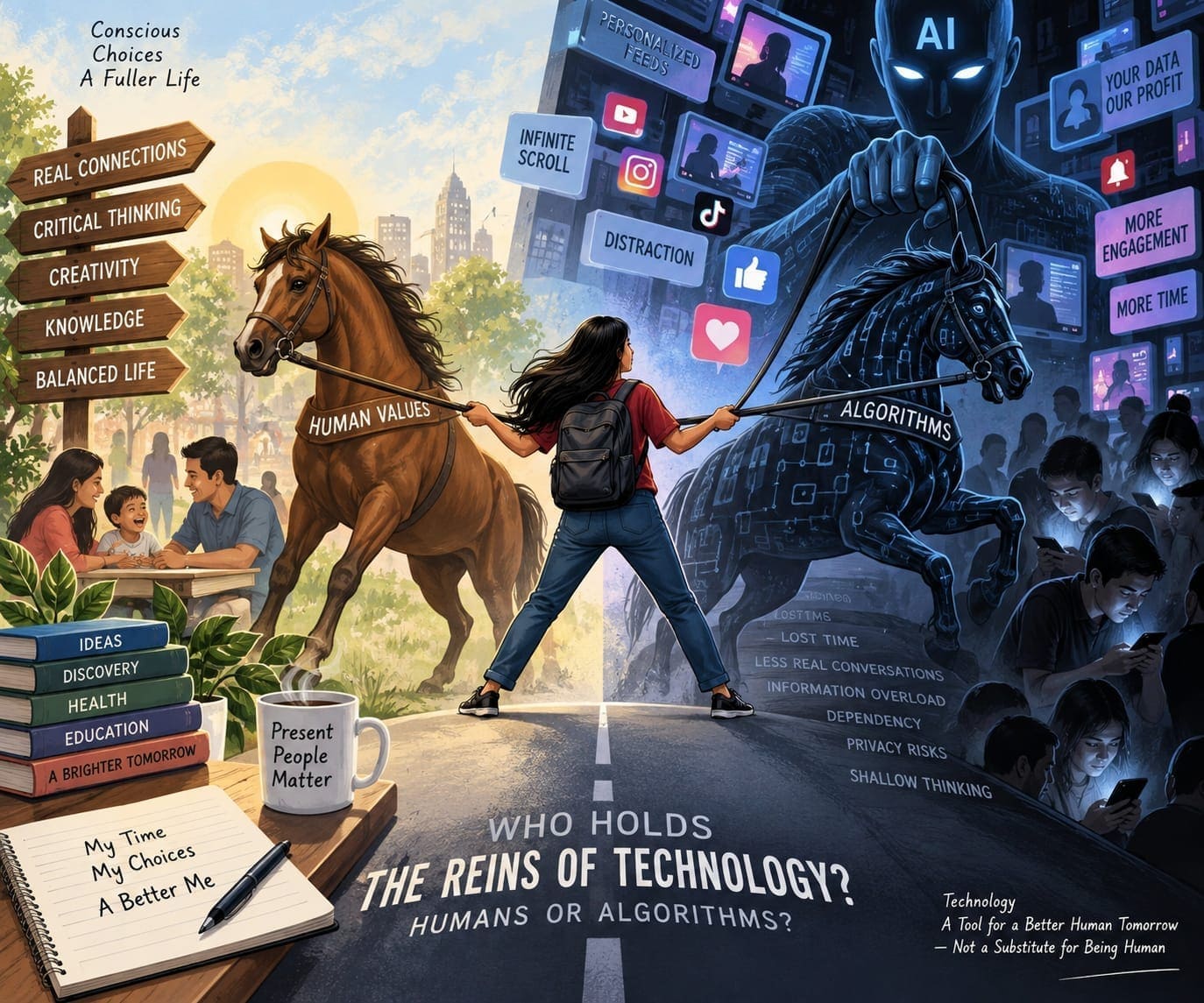
It is worth asking ourselves a simple question: Am I using my phone, or is my phone using my time and attention?
Technology is one of humanity’s remarkable creations. From communication, education, healthcare, agriculture, business and banking to research, technology has made our work faster and easier in almost every sphere of life. Tasks that once took hours can now be completed within moments. There is no doubt that technology has become one of the major driving forces behind the progress of civilization.
But the problem does not lie in the existence of technology itself. The problem begins when technology evolves from a tool that meets our needs into a force that influences our habits and behavior.
The algorithms of social media platforms analyze users’ preferences, behaviors and interests and present them with specific content. As a result, we often feel that we are the ones making the decisions. Yet an invisible technological framework is also working behind the scenes—shaping where our attention goes, what repeatedly appears before us, and even which subjects we spend more time engaging with.
This is not merely a question of time; it is also a question of independent thought.
Today, access to information is easier than ever. But an abundance of information does not necessarily mean knowledge, and information found online is not automatically the truth. The first search result, a popular opinion on social media, or an answer generated by AI should never be accepted as absolute truth without verification and critical evaluation. Technology should assist our thinking, but it should never be allowed to think entirely on our behalf.
The rapid advancement of artificial intelligence has made this discussion even more important. AI can simplify human tasks, analyze information and generate new ideas. But if people gradually surrender their own judgment, creativity and decision-making abilities to technology, convenience may eventually turn into dependency.
The most subtle transformation is taking place within our relationships. People sitting in the same room often remain absorbed in their individual screens instead of talking to one another. Children sit beside their parents while remaining engaged with their phones; even when friends meet, their attention may be elsewhere. Although technology allows us to communicate instantly with people across the world, we seem to have less time to understand the feelings of the person sitting right beside us.
Technology has connected us, but it has never become a substitute for human presence.
Alongside this comes the question of personal privacy. Every day, we leave behind our preferences, locations, photographs, contacts and various other forms of information across digital platforms. Therefore, while enjoying the benefits of technology, it is equally essential to remain conscious of the security and responsible use of our personal data.
So, should we abandon technology? Certainly not. Modern life without technology is almost unimaginable. What we need instead is to develop a healthy and conscious relationship with technology.
Spending some time away from technology every day, reducing unnecessary notifications, verifying information, avoiding blind dependence on AI, and developing the habit of having face-to-face conversations with family members—these small steps can form the foundation of digital discipline.
The issue is particularly important in the case of children and adolescents. Completely keeping them away from technology is neither realistic nor necessary. Rather, they should be taught how to use technology for knowledge, creativity and constructive purposes.
The Creator has endowed human beings with conscience, judgment and the ability to think independently. Disabling these abilities and becoming completely dependent on machines is not consistent with human dignity. No matter how advanced technology becomes, its purpose should be to enrich human life—not to control it.
Therefore, the most important question today is not how powerful technology has become. The real question is—how firmly can human beings retain their conscience and self-control while using that power?
Because technology is a tool created by us. Let the tool remain in our hands—we must never become tools in its hands.
A screen can give us information, speed and opportunities. But the meaning of life, the value of relationships, and the choice of which path to follow—the right and responsibility to make those decisions still belong to us.
In the age of technology, perhaps the greatest form of freedom is not to abandon technology, but to use it while maintaining control over ourselves.
And so, I leave the readers with a final question for their conscience—
It is not how much technology has changed our lives that matters most; what truly matters is how much of that change we have consciously embraced, and how much we have accepted without even realizing it.
Are we still users of technology today, or are we gradually becoming followers of a life shaped by it?

Author Biography:
Rehana Ferdouse is a columnist, analytical writer, and voice artist from Bangladesh. She regularly contributes to leading national newspapers and periodicals, writing on society, culture, economics, public life, and contemporary social issues. She earned both her Bachelor’s and Master’s degrees in Economics with First Class distinction from Eden Mohila College. Her work is characterized by evidence-based analysis, critical thinking, and a balanced approach to issues of public interest. In addition to her writing, she is recognized for her contributions as a voice artist in recitation and documentary narration. She currently serves as the Vice Chairperson of the Social Welfare Department of the Executive Committee of the Central Police Women’s Welfare Association (PUNAK), where she actively supports initiatives related to women’s empowerment, social welfare, and community development.

- Md. Saiful Islam Journalisthttps://thebusinessin.com/author/saifuljournalist/

- Md. Saiful Islam Journalisthttps://thebusinessin.com/author/saifuljournalist/

- Md. Saiful Islam Journalisthttps://thebusinessin.com/author/saifuljournalist/

- Md. Saiful Islam Journalisthttps://thebusinessin.com/author/saifuljournalist/