A regulator under scrutiny, a market under pressure
By Ali Kodar Polash
Bangladesh’s stock market is once again grappling with a crisis of confidence.
This time, the controversy is not about a listed company or a rogue broker —
it is about the regulator itself.
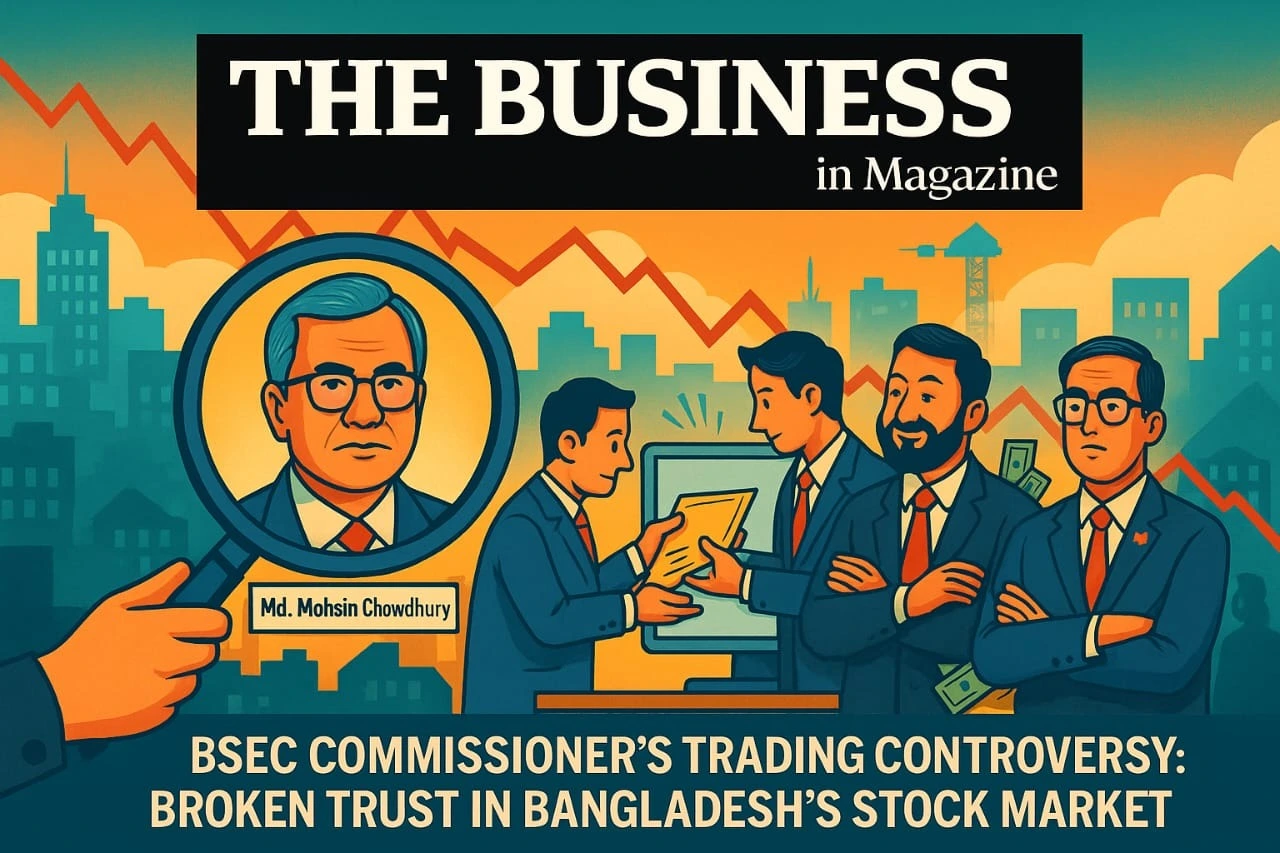
Allegations have surfaced that Md. Mohsin Chowdhury, a Commissioner of the Bangladesh Securities and Exchange Commission (BSEC), engaged in share trading under his own name, in violation of existing laws and basic principles of regulatory ethics. For a market already struggling with trust, the idea that a top regulator might be trading for personal gain has triggered anger, anxiety and a fresh wave of questions.
—
The allegation: A regulator on the trading floor
According to market sources, Commissioner Mohsin Chowdhury is alleged to have maintained an active BO (beneficiary owner) account with Zero One Limited, a brokerage house under the Chittagong Stock Exchange (CSE). Through this account, he is reported to have executed trades while serving in a powerful regulatory position.
Under best practices — and in spirit, under the country’s own regulatory framework — senior officials of the securities regulator are expected to stay away from direct share trading, precisely to avoid:
Conflicts of interest
Misuse of privileged information
And any perception that they could benefit from decisions they help to make
When those expected to enforce fair rules step onto the trading floor themselves, the line between referee and player becomes dangerously blurred.
Why this matters for market integrity
For many small investors, this controversy has reopened old wounds. Bangladesh’s capital market has lived through:
Price manipulation
Collusive trading
And cycles of boom and bust that wiped out the savings of thousands
In that context, the regulator’s moral authority is not an abstract concept — it is the last pillar holding up whatever trust remains.
If a Commissioner is seen to be trading shares for personal gain, investors naturally ask:
Who really has the inside track in this market?
Are decisions being made in the interest of all investors, or in the interest of a connected few?
If the watchdog is inside the game, who is left to guard the rules?
Even before any legal conclusion, the perception of conflict of interest alone can be enough to damage the regulator’s credibility — and credibility is the core currency of any financial market.
Politically connected investors: a quiet source of unease
In Bangladesh, the concern is not limited to one official. Over the years, investigative reports have highlighted how politically connected officials and business elites have built unusual fortunes through the stock market.
Some senior bureaucrats and influential figures have been reported to:
Accumulate large stakes in listed companies
Benefit from preferential access to private placements or pre-IPO shares
Appear to grow their wealth far beyond what their official incomes would justify
These cases rarely lead to high-profile convictions or visible penalties. But they leave a deep impression on ordinary investors. If those with access to power also have early access to information, better terms, or informal influence over price movements, then the promise of a “level playing field” starts to feel like a slogan rather than a reality.
The issue is not only what is legal;
it is what looks fair.
When the public comes to believe that rules are flexible for the powerful and rigid for everyone else, that belief itself becomes a form of corruption — a slow erosion of trust that weakens both the market and the broader economy.
Global backdrop: AI bubble, insider trading and cyber fraud
This is not just a Bangladeshi story. Around the world, stock markets are facing a different but related set of challenges:
The AI bubble and market volatility
Shares linked to artificial intelligence (AI) have surged dramatically in major markets. While some of this reflects real technological progress, many analysts warn of a potential speculative bubble — where valuation runs far ahead of fundamentals.
If that bubble bursts, it could trigger sharp corrections, especially in tech-heavy indices, and expose how much of the recent rally was built on hype rather than earnings.
Insider trading crackdowns
In countries like India, regulators have begun to take a tougher line on insider trading. The Securities and Exchange Board of India (SEBI), for example, has in high-profile cases ordered the disgorgement of large sums of illegal profit from individuals and entities that traded on privileged information.
Such crackdowns send a message:
information advantage is not supposed to be a private currency.
Cyber fraud and fake “investment gurus”
At the retail level, a different kind of threat is growing fast:
online investment scams.
On social media, thousands of small investors are being targeted by:
Fake “stock signal” groups
Bogus advisory services
Ponzi-style schemes disguised as trading clubs
These scams exploit both financial illiteracy and the digital shift in trading. Once money is sent to an unregulated platform or anonymous account, it often disappears without trace.
A fragile moment for Bangladesh’s market
Against this global background, the accusations against a BSEC Commissioner land at a particularly delicate moment for Bangladesh:
The economy is slowing compared to the past decade
Inflation and living costs have strained household budgets
And the country needs a healthy, trusted capital market to mobilise long-term investment
Every new controversy chips away at that trust.
What needs to happen next
Market experts and investor groups broadly agree on a few urgent steps:
1. Transparent, impartial investigation
The allegations against the BSEC Commissioner must be examined by a credible, independent process.
If rules were broken, there should be clear consequences. If not, the findings must still be published transparently.
2. Stricter conflict-of-interest rules
Senior regulators, policymakers and politically exposed persons (PEPs) should face clear, enforceable restrictions on trading in the markets they oversee.
Disclosure requirements and post-employment “cooling-off” periods should be strengthened.
3. Visible enforcement, not just rules on paper
Bangladesh already has many of the right words in its regulations.
What investors want to see now is consistent enforcement — applied equally to the powerful and the ordinary.
4. Investor education and digital protection
As trading becomes more digital, regulators and exchanges must invest in warning campaigns against online scams and misleading advice.
Genuine, regulated brokers and platforms must be clearly distinguished from fraudulent ones.
The hidden cost of broken trust
Capital markets live and die on trust.
When investors believe the game is rigged — that insiders play by different rules, that regulators are not neutral, that politically connected actors never lose — they don’t just lose money; they lose faith. They stop investing. They move savings into gold, cash, or property. Entrepreneurship shrinks. Long-term projects go unfunded.
That is the hidden cost of a broken trust in banking and capital markets.
Bangladesh still has time to correct course. But only if those entrusted with oversight understand that their behaviour is not just a private matter — it is the foundation on which the entire market stands.

- admin1@gmail.comhttps://thebusinessin.com/author/admin1gmail-com/

- admin1@gmail.comhttps://thebusinessin.com/author/admin1gmail-com/

- admin1@gmail.comhttps://thebusinessin.com/author/admin1gmail-com/

- admin1@gmail.comhttps://thebusinessin.com/author/admin1gmail-com/