By Ali Kodar Polash
A Story from the Streets of Motijheel
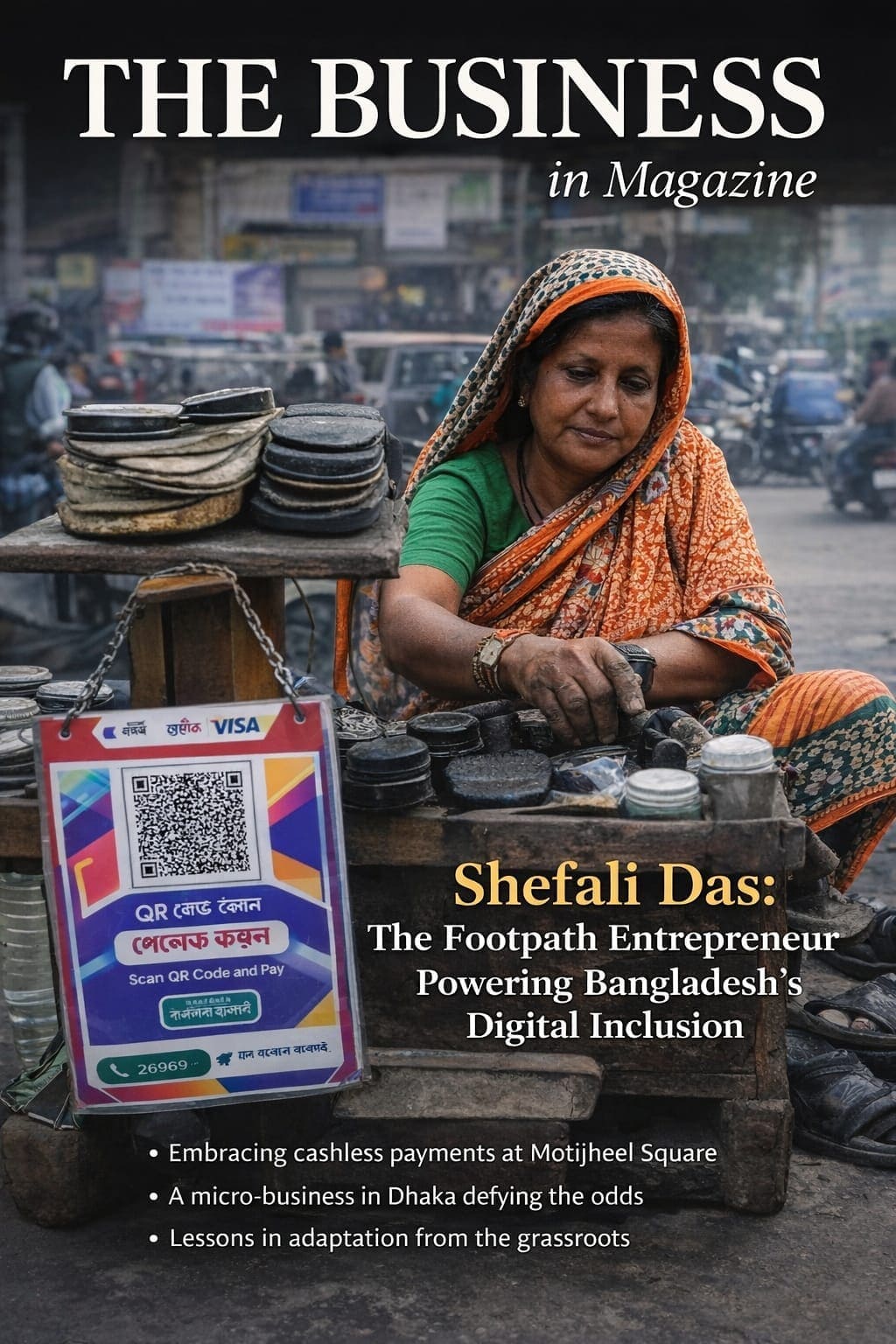
In the heart of Dhaka’s financial district, where institutions define economic power and structure, a quiet yet powerful transformation is taking place on the footpath. Just outside Bangladesh Bank, amid the rush of bankers, office workers, and daily commuters, sits Shefali Das. A cobbler by profession, she represents a new face of Bangladesh’s evolving economy.
Her workspace is simple. A wooden box, a few brushes, polish tins, and worn-out tools. Yet, what makes her stand out is not the scale of her business, but the shift in her approach. Hanging beside her workstation is a QR code board, opening her services to a completely new form of transaction.
Breaking the Cash Barrier
Traditionally, small service providers like cobblers have depended entirely on cash. Transactions were small, often limited by the availability of loose change. Customers without cash would walk away, and opportunities were lost in silence.
Shefali Das has broken that cycle.
With digital payment options such as bKash, Nagad, Rocket, Visa, and Bangla QR, she now accepts payments instantly, even for services worth as little as ten or twenty taka. What was once a limitation has now become a competitive advantage.
This transformation is not just about convenience. It is about access, continuity, and financial inclusion.
Technology at the Grassroots
The success of any digital economy depends on how deeply it penetrates the grassroots. While urban businesses and corporate entities have long embraced digital systems, the real milestone lies in adoption at the informal level.
Shefali Das stands at that intersection.
Without formal training or institutional support, she has adapted to a system that many still struggle to understand. Her decision reflects a growing awareness among micro-entrepreneurs that technology is no longer optional. It is essential.
Her small stall now operates within the same digital ecosystem as banks and multinational companies. This alignment signifies a structural shift in how economic participation is evolving in Bangladesh.
Customer Convenience, Redefined
In today’s fast-paced urban life, convenience defines customer behavior. Many no longer carry sufficient cash, relying instead on mobile wallets and digital transactions. By accepting digital payments, Shefali Das has aligned her services with modern consumer expectations.
The impact is immediate.
Customers can pay without hesitation. Transactions are faster. Trust is enhanced. And most importantly, no service is lost due to the absence of cash.
Her business has not physically expanded, but its accessibility has grown significantly.
Financial Inclusion in Practice
Digital Bangladesh is often discussed in terms of infrastructure, policy, and innovation. However, its true success is reflected in stories like this.
Shefali Das is not part of a formal financial institution. Yet, through digital payments, she is now connected to the broader financial system. Her earnings are traceable, her transactions are recorded, and her financial presence is more visible than ever before.
This is financial inclusion in its most practical form.
It demonstrates how technology can bridge the gap between formal and informal economies, creating opportunities where none existed before.
The Power of Adaptation
What makes this story truly compelling is not the technology itself, but the mindset behind it.
Shefali Das operates in one of the most challenging segments of the economy. Limited resources, uncertain income, and physical hardship define her daily life. Yet, she chose not to remain confined within those limitations.
Instead, she adapted.
Her willingness to embrace change reflects a deeper entrepreneurial instinct. She understood the shift in customer behavior and responded accordingly. This ability to adapt, rather than resist, is what defines sustainable growth in any business environment.
A Symbol of a Changing Bangladesh
Bangladesh’s economic progress is often measured through macro indicators. Growth rates, exports, and infrastructure development dominate the narrative. But the real transformation lies in stories that rarely make headlines.
It lies in the footpath entrepreneur who accepts digital payments.
It lies in the worker who becomes part of a financial network without stepping into a bank.
It lies in the silent integration of technology into everyday life.
Shefali Das represents that transformation.
Her small workspace is more than a place of service. It is a symbol of a nation adapting, evolving, and moving forward.
Insight Beyond Scale
In the world of business, scale is often equated with success. Large investments, expanding operations, and market dominance define conventional achievements.
But stories like Shefali Das challenge that perception.
Her impact is not measured by size, but by relevance. Not by revenue, but by resilience. Not by expansion, but by adaptation.
She represents a new kind of entrepreneur. One who operates at the smallest scale, yet reflects the largest shift.
And in that lies the true insight.
Courtesy: Indrajit Bashak
Author Profile: Ali Kodor Polash (আলী কদর পলাশ) is a distinguished journalist, editor, and publisher with over three decades of experience in Bangladesh’s newspaper industry. He began his editorial and publishing journey in 1991 by founding the daily newspaper Dainik Mathabhanga in Chuadanga.
On January 1, 1992, he established Ei Amar Desh, which has since evolved from a weekly into a widely recognized daily newspaper. He is also the founder of Dainik Jhenaidah, the first daily newspaper of Jhenaidah district, launched on April 14, 1993, as well as Dainik Adhibeshon.
Currently, he serves as the Chief Editor and CEO of Dainik Mukhaptra, a publication of Diamond World Group. In addition, he contributes to modern journalism and economic analysis through his digital platform The Business In.
His writing is deeply rooted in grassroots journalism, enriched by decades of hands-on experience, which remains the defining strength of his editorial voice.

- Md. Saiful Islam Journalisthttps://thebusinessin.com/author/saifuljournalist/

- Md. Saiful Islam Journalisthttps://thebusinessin.com/author/saifuljournalist/

- Md. Saiful Islam Journalisthttps://thebusinessin.com/author/saifuljournalist/

- Md. Saiful Islam Journalisthttps://thebusinessin.com/author/saifuljournalist/