Aleen Mahbub
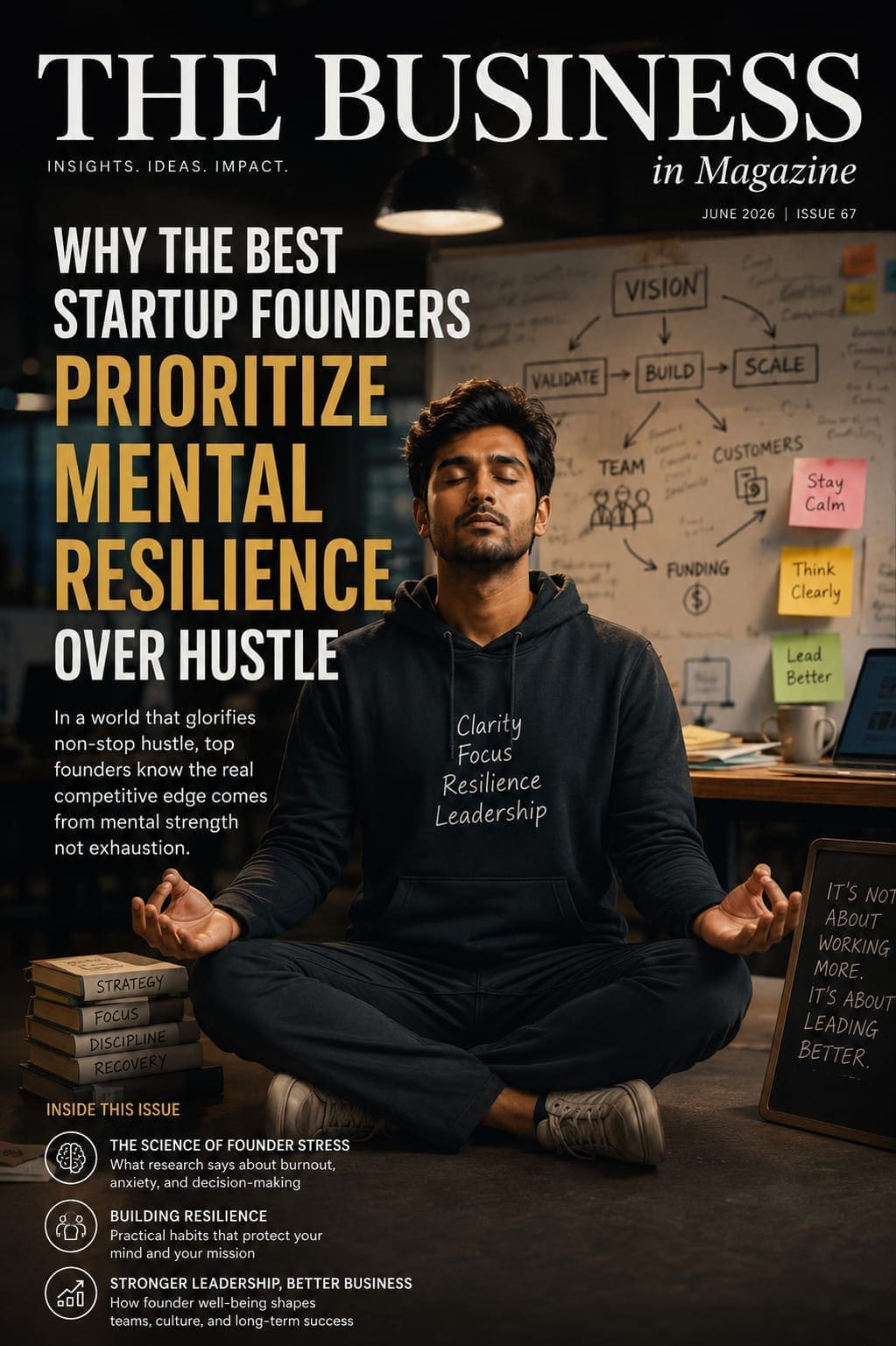
The startup ecosystem celebrates resilience, ambition, and relentless execution. Founders are often admired for working 16-hour days, sacrificing weekends, and carrying the weight of uncertainty with unwavering confidence. Yet behind the success stories lies a quieter reality founder stress has become one of the most underestimated business risks.
Stress is frequently viewed as a personal issue, but evidence suggests it is also a strategic challenge. It influences judgment, creativity, leadership, team morale, fundraising, and ultimately business performance. For first-time founders, learning to manage stress is not about achieving work-life balance alone. It is about building a company capable of surviving uncertainty.
Building a startup means operating in an environment where uncertainty is constant. Unlike established businesses, startups must validate products, attract customers, secure funding, and build teams simultaneously, often with limited resources.
Recent research by European startup publication Sifted paints a concerning picture of founder well-being. In a 2025 survey of startup founders, 54% reported experiencing burnout during the previous year, 75% experienced anxiety, and nearly half described their mental health as “bad” or “very bad.” The findings suggest that psychological strain has become a defining characteristic of early-stage entrepreneurship rather than an occasional challenge.
This is consistent with broader evidence from global entrepreneur surveys, which continue to identify anxiety, financial uncertainty, burnout, and loneliness as the most common mental health challenges among founders.
Stress does not remain confined to the individual founder.Leadership researchers have long shown that chronic stress reduces executive functioning the cognitive processes responsible for planning, prioritization, memory, and decision-making. Under prolonged pressure, leaders become more reactive, less innovative, and increasingly susceptible to poor judgment.For startups, where every strategic decision may determine survival, impaired decision-making carries substantial financial consequences.Founder well-being therefore represents an operational issue, not merely a health issue.
The entrepreneurial world has romanticized exhaustion for decades.Working continuously is often interpreted as commitment. Sleeping less is viewed as evidence of ambition. However, productivity research consistently challenges this assumption.
Working longer hours does not necessarily produce better outcomes. Instead, excessive workloads increase the likelihood of cognitive fatigue, emotional exhaustion, and burnout, while reducing creativity and strategic thinking. Modern entrepreneurship increasingly requires clarity of thought rather than simply longer working hours.
High-performing founders are distinguished not by how many hours they work but by how effectively they allocate their physical and mental energy.
Cash flow uncertainty remains one of the strongest drivers of entrepreneurial stress.Unlike salaried professionals, founders often face months without stable income while remaining responsible for employee salaries, investor expectations, product development, and operating expenses.
This financial uncertainty creates continuous psychological pressure that influences everyday decisions from hiring to pricing to fundraising strategies.
Rather than attempting to eliminate uncertainty entirely, successful founders focus on building financial resilience through realistic budgeting, maintaining emergency cash reserves where possible, and establishing measurable business milestones that reduce unnecessary panic.
Leadership can be surprisingly isolating. Employees expect confidence.Investors expect optimism.Customers expect reliability.As a result, many founders feel unable to openly discuss fear, uncertainty, or self-doubt.This emotional isolation increases psychological stress while reducing opportunities for constructive feedback.
Research increasingly identifies founder communities, peer networks, mentors, and executive coaching as valuable protective factors that improve resilience during difficult business periods.
Managing stress systematically is essential for long-term professional success, and organizational psychology offers several practical strategies to achieve it. First, treating recovery as importantly as productivity through adequate sleep, exercise, and regular breaks greatly improves cognitive focus and emotional balance. Mental energy can also be preserved for strategic decisions by reducing decision fatigue through daily routines, automation, and clear delegation. Additionally, separating personal identity from business outcomes helps professionals view setbacks and failures as learning opportunities rather than personal defeats. It is equally important to build a strong support system of mentors, peers, or professionals who can provide perspective during challenging times. Ultimately, by focusing only on controllable variables like execution and quality, rather than unpredictable external factors, individuals can maintain the emotional stability needed to build lasting resilience.
A founder’s emotional state influences organizational culture more than many entrepreneurs realize.Stress affects communication quality, conflict resolution, employee motivation, and strategic consistency.Calm leaders build psychologically safer workplaces where teams are more willing to innovate, share concerns, and solve problems collaboratively.
Conversely, founders experiencing unmanaged stress often unintentionally create cultures characterized by urgency, confusion, and emotional exhaustion.In this sense, investing in founder well-being is also an investment in organizational performance.
Startup discussions frequently revolve around capital, technology, artificial intelligence, product-market fit, and scaling strategies.Yet one of the strongest competitive advantages remains largely invisible: the founder’s capacity to make clear decisions under pressure.
The companies most likely to endure are not necessarily those led by founders who work the longest hours. They are often led by entrepreneurs who understand that sustainable leadership requires emotional resilience, disciplined recovery, and continuous learning.Managing stress is therefore not a distraction from entrepreneurship.It is an essential component of entrepreneurial strategy.As startup ecosystems become increasingly competitive, founder well-being should no longer be viewed as a personal luxury. It should be recognized as a business imperative that influences innovation, leadership quality, and long-term organizational success.

Writer : Aleen Mahbub is an Author focused on entrepreneurship, SME growth, and business insights.

- Md. Saiful Islam Journalisthttps://thebusinessin.com/author/saifuljournalist/

- Md. Saiful Islam Journalisthttps://thebusinessin.com/author/saifuljournalist/

- Md. Saiful Islam Journalisthttps://thebusinessin.com/author/saifuljournalist/

- Md. Saiful Islam Journalisthttps://thebusinessin.com/author/saifuljournalist/