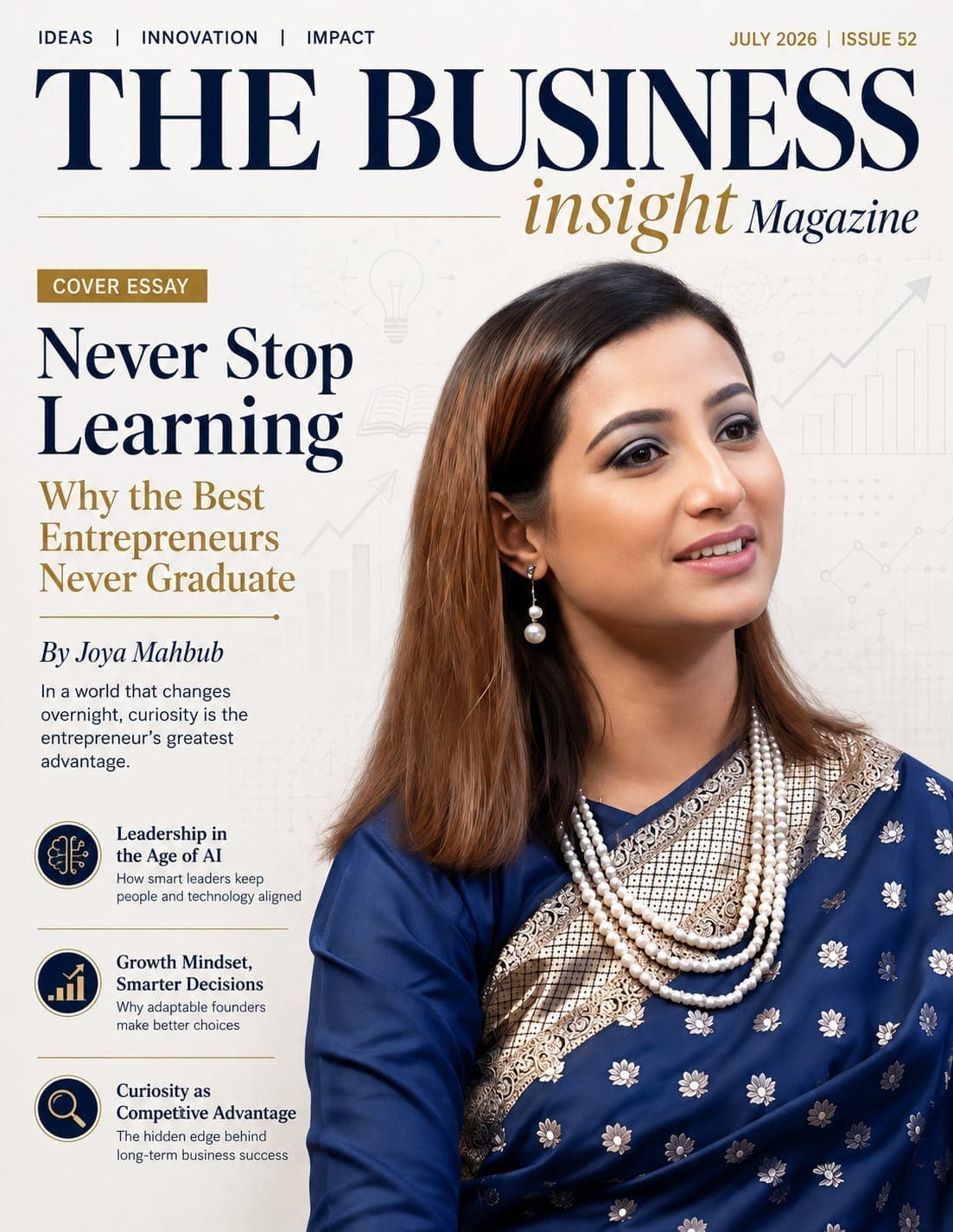
By Joya Mahbub
The image of a successful entrepreneur often revolves around bold decisions, innovative ideas, and financial success. We celebrate founders who build thriving businesses, create jobs, and disrupt industries. Yet behind every resilient entrepreneur lies a quieter habit that rarely receives the same attention: an unwavering commitment to lifelong learning. In today’s rapidly changing economy, knowledge has become one of the most valuable forms of capital. Markets evolve, customer expectations shift, technologies emerge overnight, and business models become obsolete faster than ever before. Under these conditions, yesterday’s expertise is no guarantee of tomorrow’s success. The entrepreneurs who continue to thrive are not necessarily those who know the most, they are those who remain curious enough to keep learning.

As futurist Alvin Toffler famously observed, “The illiterate of the 21st century will not be those who cannot read and write, but those who cannot learn, unlearn, and relearn.” Few professions embody this idea more clearly than entrepreneurship. Research consistently supports the value of continuous learning. The World Economic Forum has repeatedly highlighted that rapid technological change requires constant reskilling and upskilling, with employers increasingly valuing adaptability alongside technical expertise. Likewise, the Organisation for Economic Co-operation and Development (OECD) argues that lifelong learning is essential for economic resilience, innovation, and long-term productivity in an increasingly knowledge-driven economy.
Entrepreneurship itself is an ongoing learning journey. Every customer complaint teaches a lesson about service. Every failed product reveals weaknesses in market understanding. Every hiring mistake improves leadership judgment. Every financial setback strengthens decision-making. The most successful founders do not see these experiences as failures but as tuition fees paid to the real-world business school.
Author Eric Ries, in The Lean Startup, captured this mindset perfectly: “The only way to win is to learn faster than anyone else.” His philosophy reminds entrepreneurs that progress depends less on avoiding mistakes and more on learning from them quickly enough to improve. This mindset also distinguishes a fixed mindset from a growth mindset. Psychologist Carol Dweck’s research demonstrates that individuals who believe abilities can be developed through effort are more likely to embrace challenges, persist through setbacks, and ultimately achieve greater success. Entrepreneurs with a growth mindset actively seek feedback, remain open to new perspectives, and continuously refine their strategies instead of assuming they already have the right answers.
Around the world, leading entrepreneurs embody this philosophy. Bill Gates has long been known for reading dozens of books each year. Warren Buffett reportedly spends much of his working day reading financial reports, books, and industry publications. Microsoft CEO Satya Nadella has often spoken about the importance of replacing a “know-it-all” culture with a “learn-it-all” culture. These leaders understand that learning is not something reserved for the beginning of a career, it is the foundation of sustained leadership.
For entrepreneurs in Bangladesh, continuous learning has become even more important. The country’s startup ecosystem is growing, digital commerce is expanding, and small and medium-sized enterprises are increasingly competing in regional and global markets. At the same time, artificial intelligence, automation, digital marketing, and data analytics are transforming how businesses operate. Entrepreneurs who stop learning risk being left behind by competitors who embrace new technologies and changing consumer behaviour.
Learning today extends far beyond formal education. Entrepreneurs can develop new skills through online courses, podcasts, webinars, professional networks, industry conferences, books, mentoring relationships, and conversations with customers themselves. Some of the most valuable lessons come not from classrooms but from carefully listening to people, observing trends, and reflecting honestly on both successes and failures.
Importantly, learning is not limited to business knowledge alone. Emotional intelligence, communication, negotiation, leadership, resilience, and critical thinking have become equally essential. Entrepreneurs manage people as much as products. They negotiate partnerships, inspire teams, resolve conflicts, and build trust with customers. These human skills require continuous practice and development throughout one’s career.
Yet many entrepreneurs unintentionally stop learning once they achieve initial success. Confidence gradually turns into certainty, and certainty can become complacency. Businesses that once disrupted industries may themselves become resistant to change. History offers countless examples of once-dominant companies that failed because they assumed yesterday’s formula would continue working tomorrow. Continuous learning is therefore not merely a path to growth, it is insurance against irrelevance.
Author Peter Drucker wisely noted, “Knowledge has to be improved, challenged, and increased constantly, or it vanishes.” His words remain especially relevant in today’s innovation-driven economy.
Perhaps the greatest lesson is that learning requires humility. The willingness to admit “I don’t know” is often the beginning of meaningful growth. Entrepreneurs who ask questions, seek mentors, welcome constructive criticism, and remain intellectually curious position themselves to identify opportunities others overlook.
Ultimately, the best entrepreneurs never truly graduate. They view every conversation as a lesson, every challenge as feedback, every mistake as data, and every day as another opportunity to grow. Their greatest competitive advantage is not simply their ideas or resources but their capacity to keep learning in a world that never stops changing.
In the end, business success belongs not to those who believe they have all the answers, but to those who never stop searching for better questions.

- Md. Saiful Islam Journalisthttps://thebusinessin.com/author/saifuljournalist/

- Md. Saiful Islam Journalisthttps://thebusinessin.com/author/saifuljournalist/

- Md. Saiful Islam Journalisthttps://thebusinessin.com/author/saifuljournalist/

- Md. Saiful Islam Journalisthttps://thebusinessin.com/author/saifuljournalist/