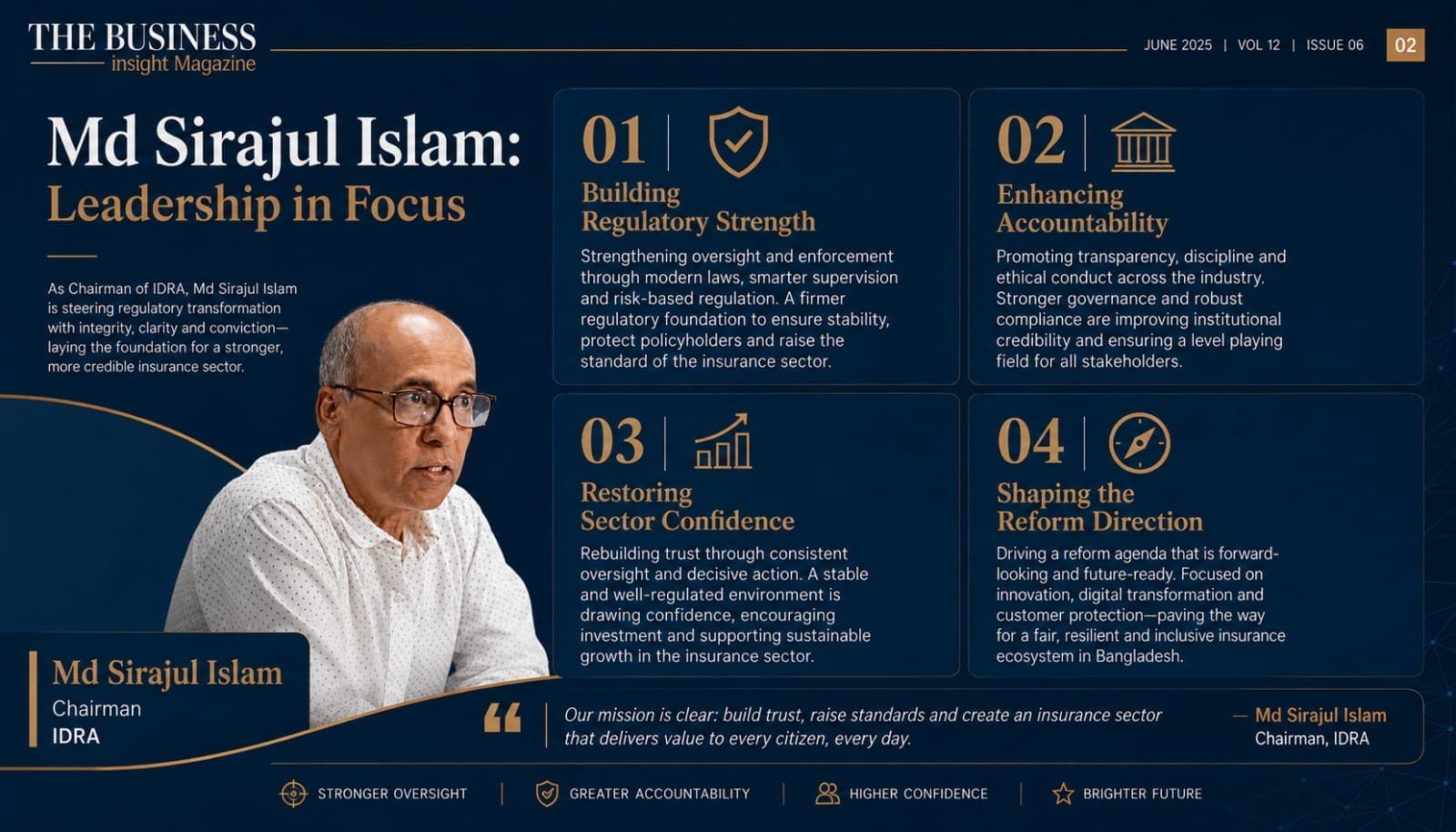
Former central banker Sirajul Islam joins as Member (Administration) • Governance specialist Mir Nadia Nivin took charge as chairman in June • Nearly Tk 7,800 crore in claims remain unsettled • Restoring policyholders’ trust emerges as the regulator’s toughest test
By Our Correspondent
For millions of policyholders, insurance is supposed to provide security when life takes an unexpected turn. They pay premiums for years believing that when a policy matures, an accident occurs or a business suffers a loss, the insurer will stand beside them.
For too many customers in Bangladesh, however, that promise has become uncertain.
Delayed claim settlements, weak financial management, questionable investments, governance failures and declining public confidence have pushed the country’s insurance industry into one of its most difficult periods in recent years.
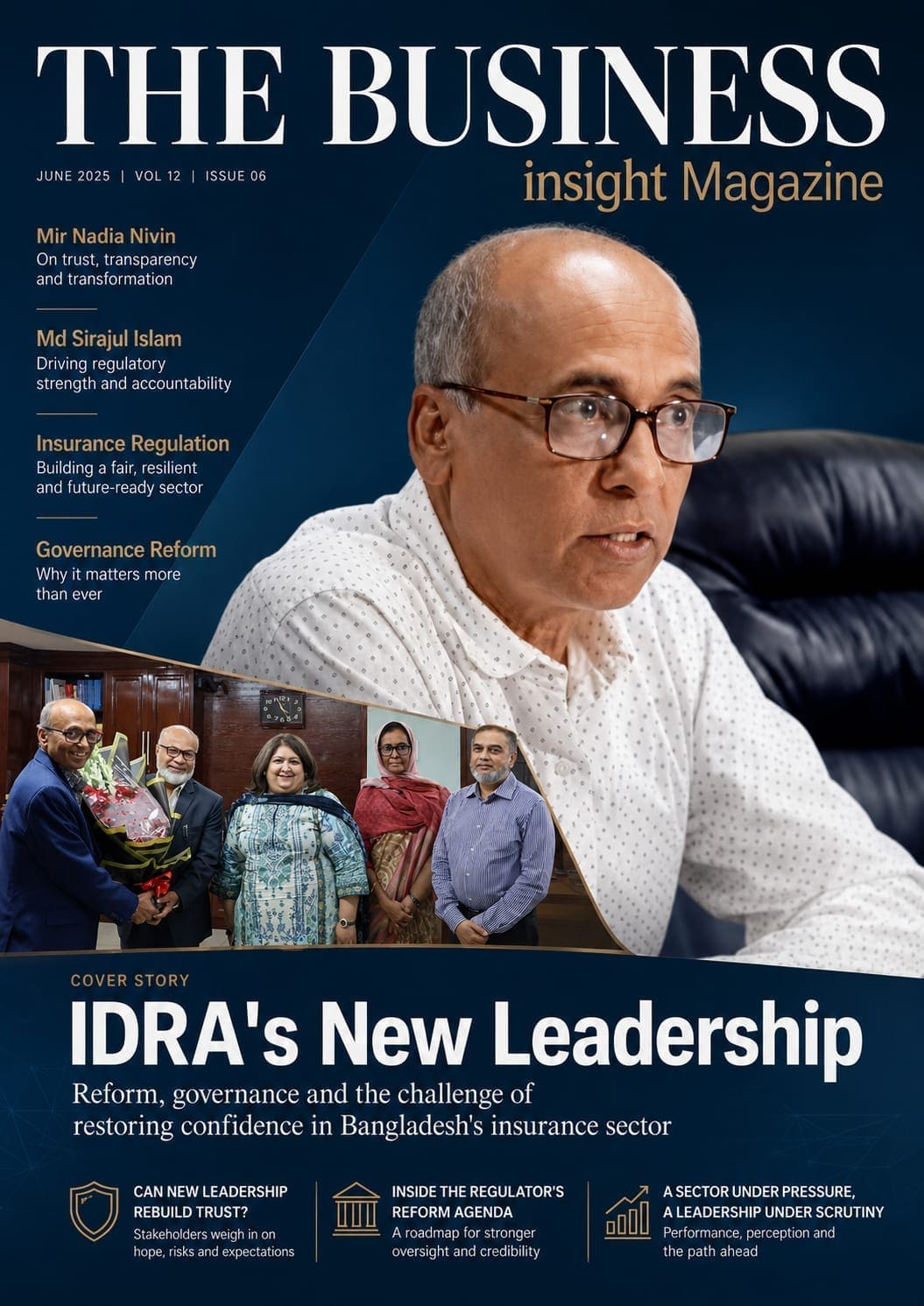
Against this backdrop, the Insurance Development and Regulatory Authority of Bangladesh, or IDRA, is gradually being reshaped under a new leadership team.
Governance and institutional reform specialist Mir Nadia Nivin assumed office as chairman in June. Now former Bangladesh Bank executive director and spokesperson Md Sirajul Islam has been appointed Member (Administration) for a three-year term.
The appointment is more than an administrative change. It comes at a time when the regulator is under mounting pressure to restore discipline to an industry where thousands of policyholders are still waiting for their money.
A Central Banker Joins the Regulator
Sirajul Islam brings decades of experience from Bangladesh Bank, where he served in senior positions including executive director and spokesperson.
His background in financial regulation, supervision and institutional administration is expected to be particularly relevant at IDRA, which faces growing demands for stronger enforcement and closer monitoring of financially weak insurers.
Under the government notification, he has been appointed Member (Administration) on a contractual basis for three years under the IDRA Act 2010.
His arrival also strengthens the regulator at a moment when the insurance industry increasingly requires the type of financial discipline traditionally associated with banking supervision.
The challenge, however, is significant.
Unlike banks, where deposit protection, liquidity supervision and capital requirements have long been central regulatory concerns, the insurance industry has struggled with fragmented databases, delayed claims, weak governance and inadequate accountability at several companies.
A Governance Specialist at the Top
The appointment of Mir Nadia Nivin as chairman in June signalled another important shift.
Her professional background is rooted in governance, institutional reform, strategic management and organisational transformation rather than conventional insurance administration alone.
She has worked in international development assignments in Bangladesh and abroad and has experience in areas such as strategic management and digital transformation.
That background may prove important because the insurance industry’s current difficulties are not simply financial.
They are also problems of governance, accountability, transparency and institutional capacity.
The central question for the new leadership is therefore not only how to rescue troubled insurers, but how to prevent the same problems from being repeated.
Nearly Tk 7,800 Crore in Claims Unsettled
The scale of the challenge is reflected most clearly in unpaid insurance claims.
According to regulatory data for the period up to March 2026, life and non-life insurers together faced claims of around Tk 10,611 crore.
Of that amount, approximately Tk 7,779 crore remained unsettled—more than 73 per cent of total claims.
The situation was particularly serious in the non-life segment, where the overwhelming majority of claims remained unresolved.
For policyholders, these numbers represent something far more personal than a balance-sheet problem.
They may represent retirement savings, family security, hospital expenses, compensation following an accident or protection for a business after a major loss.
Every delayed claim therefore weakens not only the balance sheet of an insurer but also confidence in the entire industry.
Seven Weak Insurers Account for a Major Share
A large portion of unpaid life insurance claims is concentrated among a relatively small number of financially troubled companies.
Regulatory assessments have indicated that around seven weak life insurers alone owe policyholders close to Tk 4,000 crore.
IDRA has been examining a number of possible options to address these liabilities.
These include unlocking funds trapped in banks, liquidating government securities and other eligible investments, and using saleable assets to meet policyholders’ claims.
If those measures prove insufficient, limited government support has also been discussed as a possible last resort.
Such a move, however, would raise an equally important question:
Should taxpayers be asked to rescue companies before the directors, sponsors and executives responsible for financial mismanagement are held accountable?
This is likely to become one of the most difficult policy questions facing the new regulator.
Claims Caught in the Courts
The claims crisis extends beyond insurance company offices.
Hundreds of disputes involving fire, marine and other insurance claims are pending before the courts, with several cases remaining unresolved for years.
For an industry built around the promise of timely financial protection, such delays undermine the basic purpose of insurance itself.
A business that suffers a fire cannot wait indefinitely for compensation. A family depending on a matured life policy cannot plan its future around years of litigation.
Speedier dispute resolution, therefore, must become part of the broader reform agenda.
Regulation Must Move Beyond Circulars
Bangladesh’s insurance sector has no shortage of regulations, circulars and directives.
The real weakness has often been implementation.
The new leadership will have to demonstrate that regulatory action can move beyond issuing notices and instructions.
Among the reforms now considered critical are stronger risk-based supervision, tighter scrutiny of investments, improved corporate governance, qualification standards for senior executives and better monitoring of solvency and capital adequacy.
A modern insurance regulator should be able to identify a company’s deterioration long before it reaches the point where policyholders’ money becomes trapped.
That requires stronger financial reporting, early-warning systems and timely intervention.
Digitalisation Could Change the Game
Technology may provide one of the most effective tools for rebuilding trust.
Bangladesh already has digital insurance services and policyholder information facilities, but the industry still lacks the level of integrated data infrastructure necessary for real-time supervision.
A comprehensive central database could allow the regulator to track policies, premiums, claims, investments and customer complaints across the industry.
A unique policyholder identification system could help prevent fraudulent policies, duplication and manipulation of customer records.
Policyholders should also be able to check, from a single digital platform, whether a policy is genuine, how much premium has been paid, when it matures and what stage a claim has reached.
Digitalisation would therefore not merely improve convenience.
It could become an instrument of transparency and regulatory accountability.
The Governance Question
The industry’s problems did not emerge overnight.
In several companies, aggressive expansion was not supported by sound investment management. In others, related-party transactions, weak boards, questionable asset purchases or poor internal controls contributed to financial stress.
For years, some insurers continued to collect fresh premiums even while struggling to settle older obligations.
That model cannot continue indefinitely.
If a company is unable to honour existing claims, regulators must ask whether it should be allowed to continue writing new business without a credible recovery plan.
The new leadership will also need to determine which companies can realistically be rehabilitated and which require restructuring, merger, administration or eventual exit from the market.
Keeping chronically insolvent companies alive only postpones the problem.
Restoring Confidence Will Require Visible Results
New appointments can create expectations. They cannot, by themselves, restore public confidence.
Policyholders will judge the regulator by results.
How many old claims are settled?
How quickly are complaints resolved?
How many weak companies return to financial stability?
Are directors and executives responsible for irregularities held accountable?
Are new violations detected before they become crises?
These are the questions that will define the success or failure of the new IDRA leadership.
The regulator also faces a broader strategic challenge: insurance penetration in Bangladesh remains low compared with many regional economies. Expanding the industry will be difficult unless existing customers first regain confidence in the system.
No advertising campaign can compensate for unpaid claims.
No new insurance product can succeed for long if policyholders believe their money may not be returned.
A Test of Leadership
The arrival of Mir Nadia Nivin as chairman and Sirajul Islam as Member (Administration) gives IDRA an opportunity to reset its regulatory approach.
One brings experience in governance and institutional reform; the other brings decades of central banking and financial-sector administration.
That combination could prove valuable.
But the task before them is formidable.
The immediate priorities are clear: settle legitimate claims, restore financial discipline, strengthen governance, protect policyholders and prevent new irregularities from accumulating.
The insurance industry’s crisis is ultimately a crisis of trust.
And trust cannot be restored through appointments, announcements or policy documents alone.
It will return only when policyholders see that promises are honoured, wrongdoers are held accountable and the regulator is willing to intervene before problems become disasters.
For Bangladesh’s insurance industry, the new leadership at IDRA is therefore more than another administrative transition.
It is a test of whether regulation can finally translate into protection for the people whose money the industry was created to safeguard.

- Md. Saiful Islam Journalisthttps://thebusinessin.com/author/saifuljournalist/

- Md. Saiful Islam Journalisthttps://thebusinessin.com/author/saifuljournalist/

- Md. Saiful Islam Journalisthttps://thebusinessin.com/author/saifuljournalist/

- Md. Saiful Islam Journalisthttps://thebusinessin.com/author/saifuljournalist/