Seven life insurers settle Tk 145.1 million in claims for 2,549 policyholders, but the real test is whether timely settlement becomes the rule
Bangladesh’s insurance regulator has taken a visible step to address one of the sector’s deepest problems: unpaid policyholder claims.
On September 3, the Insurance Development and Regulatory Authority, or IDRA, facilitated the payment of more than Tk 145.1 million in claims to 2,549 policyholders of seven life insurance companies.
The companies were Baira Life, Fareast Islami Life, Golden Life, Homeland Life, Padma Islami Life, Progressive Life and Sunflower Life.
For policyholders who had been waiting for their money, the payments are unquestionably welcome.
But there is a larger point that must not be lost in the celebration.
Paying a legitimate insurance claim is not an act of generosity by an insurer. It is a contractual obligation.
Insurance works because a customer pays today in return for a promise that the company will pay tomorrow, whether at maturity, after death or when another covered event occurs. Once that promise becomes uncertain, the very foundation of the industry begins to weaken.
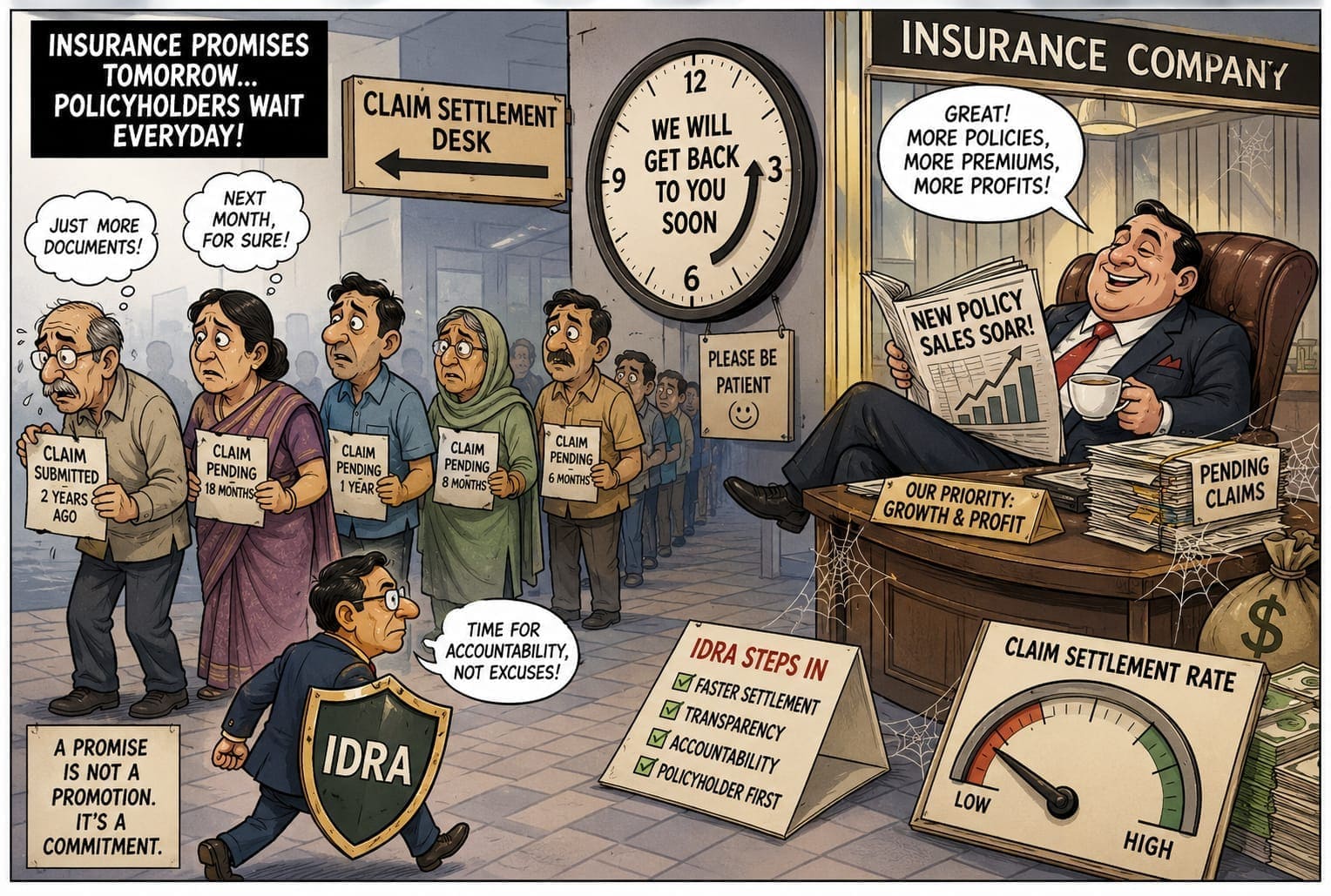
Bangladesh’s insurance industry has struggled with precisely that problem.
For years, many customers have complained of delayed settlements, repeated visits to company offices and long waits even after policies matured. In some cases, the difficulty of receiving a claim has damaged confidence not only in individual companies but in the entire sector.
This is why the latest intervention by IDRA matters.
The regulator is signalling that unsettled claims can no longer be treated merely as an internal matter between insurers and policyholders.
That is progress.
But one cheque distribution ceremony will not rebuild confidence.
The bigger question is whether the regulator can turn claim settlement into a transparent, measurable and enforceable discipline.
Every insurer should be required to disclose how many claims remain unpaid, the total amount outstanding, how long those claims have been pending and how much is being settled every month.
Companies that have sufficient assets but deliberately delay payments should face penalties.
Where an insurer no longer has the financial capacity to honour legitimate claims, the authorities should not allow the problem to drift indefinitely. Asset sales, restructuring, changes in management, mergers or other corrective measures may have to be considered.
Accountability also has to extend beyond the companies themselves.
If thousands of policyholders can wait years for their money, questions must also be asked about the effectiveness of regulatory supervision.
Policyholders are often expected to pay their premiums on time. Insurers should be held to an equally strict standard when their obligation to pay becomes due.
There cannot be one standard for customers and another for companies.
The Tk 145.1 million distributed among 2,549 policyholders is therefore important not because the amount is unusually large, but because it offers a chance to establish a new principle.
Claims must be paid on time.
That should be normal business practice, not a special event.
For IDRA, the real test begins now.
If the regulator can make timely claim settlement routine, strengthen disclosure and take visible action against chronic defaulters, confidence in Bangladesh’s insurance industry can gradually return.
If not, occasional cheque-distribution programmes will remain symbolic.
In insurance, trust is the real capital.
And the fastest way to rebuild that trust is simple: pay policyholders what they are owed, when they are owed it.

- Md. Saiful Islam Journalisthttps://thebusinessin.com/author/saifuljournalist/

- Md. Saiful Islam Journalisthttps://thebusinessin.com/author/saifuljournalist/

- Md. Saiful Islam Journalisthttps://thebusinessin.com/author/saifuljournalist/

- Md. Saiful Islam Journalisthttps://thebusinessin.com/author/saifuljournalist/