Rehana Ferdouse
The national budget is not just a statement of income and expenditure; it is a reflection of a state’s economic philosophy, development roadmap, and the government’s commitment to its citizens. The 9.38 trillion taka budget for the 2026-27 fiscal year has brought forward the goals of high growth, inflation control, and an inclusive economy. But the question remains—to what extent will this budget be able to bridge the gap between people’s expectations and actual economic capacity?
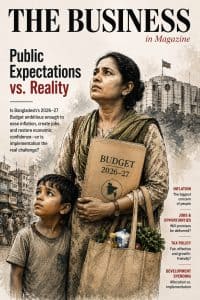
Every national budget sets the direction for a country’s economic future. It is not just a government’s spending plan; rather, it is a comprehensive policy document on which sectors the state will prioritize, how it will collect revenue, combat inflation, create employment, and create an investment environment.
The budget for the 2026-27 fiscal year came into effect at a time when Bangladesh’s economy is facing multiple challenges. High inflation, weak banking sector, revenue shortfall, sluggish private investment and global economic uncertainty have put the economy under pressure. In this context, the government has set a target of 6.5 percent growth and bringing inflation down to 7.5 percent. At the same time, a revenue collection target of Tk 695,000 crore has also been set. But a fundamental truth of economics is that setting targets is relatively easy; achieving that target requires effective implementation, efficient administration and policy consistency.
Public expectations vs. reality
The expectations of the common people of Bangladesh regarding the budget are not very complex. They want—
* Prices of essential commodities to come down,
* Employment to increase,
* Medical and education to be more accessible,
* Tax burden not to be unbearable,
* and the business and investment environment to improve.
On the other hand, the reality before the government is different. On the one hand, the pressure to increase revenue, on the other hand, development expenditure, social security, infrastructure, interest on debt and government operating expenditure – all demand money. As a result, the government has to maintain a difficult balance between meeting the expectations of the people and maintaining financial discipline. That dual reality is also clear in the budget for the 2026-27 fiscal year. The size of the budget has been increased, significant allocations have been made for education, health, social security and development expenditure. At the same time, ambitious targets have been set for revenue collection. However, from an economic perspective, the main question lies elsewhere.
If the capacity to collect revenue is not in line with the target, then a large part of the development plan risks remaining limited to paper. Past experience in Bangladesh shows that revenue targets are often not met. As a result, development expenditure has to be reduced in the middle of the year or dependence on debt has to be increased. This has a direct impact on the implementation of government projects, private investment and macroeconomic stability. In the language of economics, the success of a budget is not in its size; but in the efficiency of implementation. Because people don’t remember the budget speech in the end—they remember the real experience of market rice and pulses, medical expenses, children’s jobs, and their own purchasing power.
Overall evaluation of the budget: The bigger the goal, the bigger the challenge in implementation
The success of a budget is not in its size, but in its implementation. The budget for the 2026-27 fiscal year is ambitious. An attempt to give equal importance to growth, inflation control, revenue growth, employment, and social security can be seen in it. But the reality of the economy says that only financial allocation is not enough to achieve these goals; efficient institutions, accountable administration, transparency, and consistent implementation of policies are needed. A long-standing weakness in budget formulation in Bangladesh is the gap between allocation and implementation. Due to increased time and cost in development projects, protracted process in project approval, and delays in releasing funds—in many cases, the expected benefits do not reach the people on time. As a result, a big budget does not always ensure big results.
Revenue and Tax Policy: It is important not only to increase taxes, but also to increase the tax base. Revenue is the main force in running the state. But Bangladesh’s tax-GDP ratio is still low compared to international standards. Although high revenue targets are set every year, it is difficult to achieve them in reality.
From an economic perspective, the main goals of the tax system should be three-
First, to increase tax coverage.
Second, to ensure transparency and digital management in tax collection.
Third, to encourage honest taxpayers and effectively control tax evasion.
Simply putting additional pressure on existing taxpayers increases business costs, discourages investment and ultimately affects consumers. Therefore, tax policy should be such that, on the one hand, it increases government revenue, and on the other hand, it also maintains an environment for production, investment and employment.
Inflation: The biggest concern of the people
The biggest question of the budget for the common man is – will there be relief in the market? Inflation has significantly eroded people’s real income in the last few years. The continuous increase in food, housing, medical, education and transportation costs has put a lot of pressure on lower and middle class families. Inflation control is not only a matter of fiscal policy, it is a combined result of supply chain, agricultural production, import management, market supervision and monetary policy. Therefore, it is not enough to just set a target in the budget; effective market management must also be ensured to implement that target.
Employment and Investment: An economy is only strong when its young population can engage in productive employment. A large number of young people are entering the labor market every year in Bangladesh. If new jobs are not created for them, the benefits of economic growth will be limited. In this context, more effective incentives for private investment, small and medium enterprises, entrepreneurship development, technology-based employment and export-oriented industries in the budget are very important. Government investment can build infrastructure, but in the long run the main driver of employment is the private sector. Therefore, investment-friendly policies, an easy business environment, stable energy supply, financial sector reforms and ensuring policy continuity are the need of the hour.
Agriculture, food security and exports: the basis of sustainable growth
Agriculture is one of the main pillars of Bangladesh’s economy. Despite the expansion of the industrial and service sectors, agriculture is still an important source of food security, rural employment and foreign exchange earnings. Therefore, agriculture needs to be considered in the budget not only as a subsidy-dependent sector, but also as a competitive production and export-oriented economic sector.
The potential of Bangladesh’s mangoes, jackfruit, vegetables, potatoes, shrimp and other agricultural products in the world market is gradually increasing. But the limitations of international standards, cold chain, preservation, processing, packaging and logistics do not allow us to fully utilize our potential. If the budget includes continuous investment in the development of these infrastructures, agriculture can become a stronger sector for earning foreign exchange.
Education and Health: Investment, Not Expenditure
A state that views education and health as an expense loses its momentum in the long run. Skilled human resources are the greatest economic asset of a country. It is important to emphasize not only infrastructure in the education sector but also research, technical education, technology-based skills and education based on the needs of the labor market. Similarly, in the health sector, preventive medicine, specialized services at the district level, quality control of medicines and development of digital health systems are essential for the future.
Social Security: From Assistance to Capacity
It is difficult to achieve the desired results in the long run if social security programs are limited to providing only financial assistance. Its goal should be to increase the capacity of people, job-oriented training, create small entrepreneurs and build self-reliance. The social expenditure of the state will be more effective if, in addition to security programs for the elderly, widows, disabled and the very poor, skill development and income generation initiatives are added. Foreign Trade and Economic Diplomacy Bangladesh is gradually moving towards graduation from the Least Developed Country (LDC) list. As a result, various international trade benefits may decrease in the future. Therefore, it is important to diversify export products, explore new markets, enter into free trade agreements and strengthen economic diplomacy from now on. A modern economy is not only measured by production; it is also measured by its ability to survive in international competition.
From an economic perspective, the 2026-27 budget can be called a budget of cautious optimism. It has ambitions and development outlines, but to achieve that goal, implementation capacity, fiscal discipline, and policy continuity are needed. If revenue collection does not increase as expected, effective steps are not taken to control inflation, and efficiency in government spending is not ensured, then many of the positive goals of this budget will become difficult to implement.
For the long-term stability of the economy, a few issues should be given special importance—
Expanding tax coverage and strengthening the digital tax system.
Improving market supervision and supply chain to control inflation.
Effective reforms to improve good governance and reduce non-performing loans in the banking sector.
Ensuring easy financing for small and medium entrepreneurs.
Long-term investment in agriculture, food processing, and exports.
Effective use of allocations for education and technical skills development.
Increased access to healthcare for rural and marginalized populations.
Strict accountability in controlling time and cost in development projects.
Policy stability and a business-friendly environment to attract foreign investment.
Expanding information-based policymaking and independent evaluation systems.
The national budget is not a magic wand; it is a blueprint for possibilities. That blueprint is transformed into reality by people’s hard work, good governance, efficient administration, and political goodwill. The 2026-27 budget can open the door to new possibilities for Bangladesh—if there is determination to implement the announcements, if accountability for every taka of expenditure is ensured, and if the improvement of the quality of life of the common man is at the center of the policy. People ultimately do not remember the budget speech; they remember the price of daily necessities in the market, employment of children, fair value for farmers, investment environment for entrepreneurs, and assurance of medical treatment. Therefore, the true identity of a successful budget is not on paper, but in people’s lives. The closer the gap between expectations and reality is, the stronger Bangladesh’s economy will be and the more meaningful the national budget will become. Ultimately, the success of this budget will depend not on the announcement; but on the efficiency of implementation. People want to feel the real impact of the budget, not its size.

Author Biography:
Rehana Ferdouse is a columnist, analytical writer, and voice artist from Bangladesh. She regularly contributes to leading national newspapers and periodicals, writing on society, culture, economics, public life, and contemporary social issues. She earned both her Bachelor’s and Master’s degrees in Economics with First Class distinction from Eden Mohila College. Her work is characterized by evidence-based analysis, critical thinking, and a balanced approach to issues of public interest. In addition to her writing, she is recognized for her contributions as a voice artist in recitation and documentary narration. She currently serves as the Vice Chairperson of the Social Welfare Department of the Executive Committee of the Central Police Women’s Welfare Association (PUNAK), where she actively supports initiatives related to women’s empowerment, social welfare, and community development.

- Md. Saiful Islam Journalisthttps://thebusinessin.com/author/saifuljournalist/
- Md. Saiful Islam Journalisthttps://thebusinessin.com/author/saifuljournalist/
- Md. Saiful Islam Journalisthttps://thebusinessin.com/author/saifuljournalist/
- Md. Saiful Islam Journalisthttps://thebusinessin.com/author/saifuljournalist/