THE BUSINESS INSIGHT COVER STORY
By Ali Kodar Polash
There are places in Bangladesh where even an address is temporary.
A family builds a home on a river island. The river changes course. The land disappears. They move, rebuild and sometimes lose everything again.
How do you build a hospital in a place where the land itself may not remain?
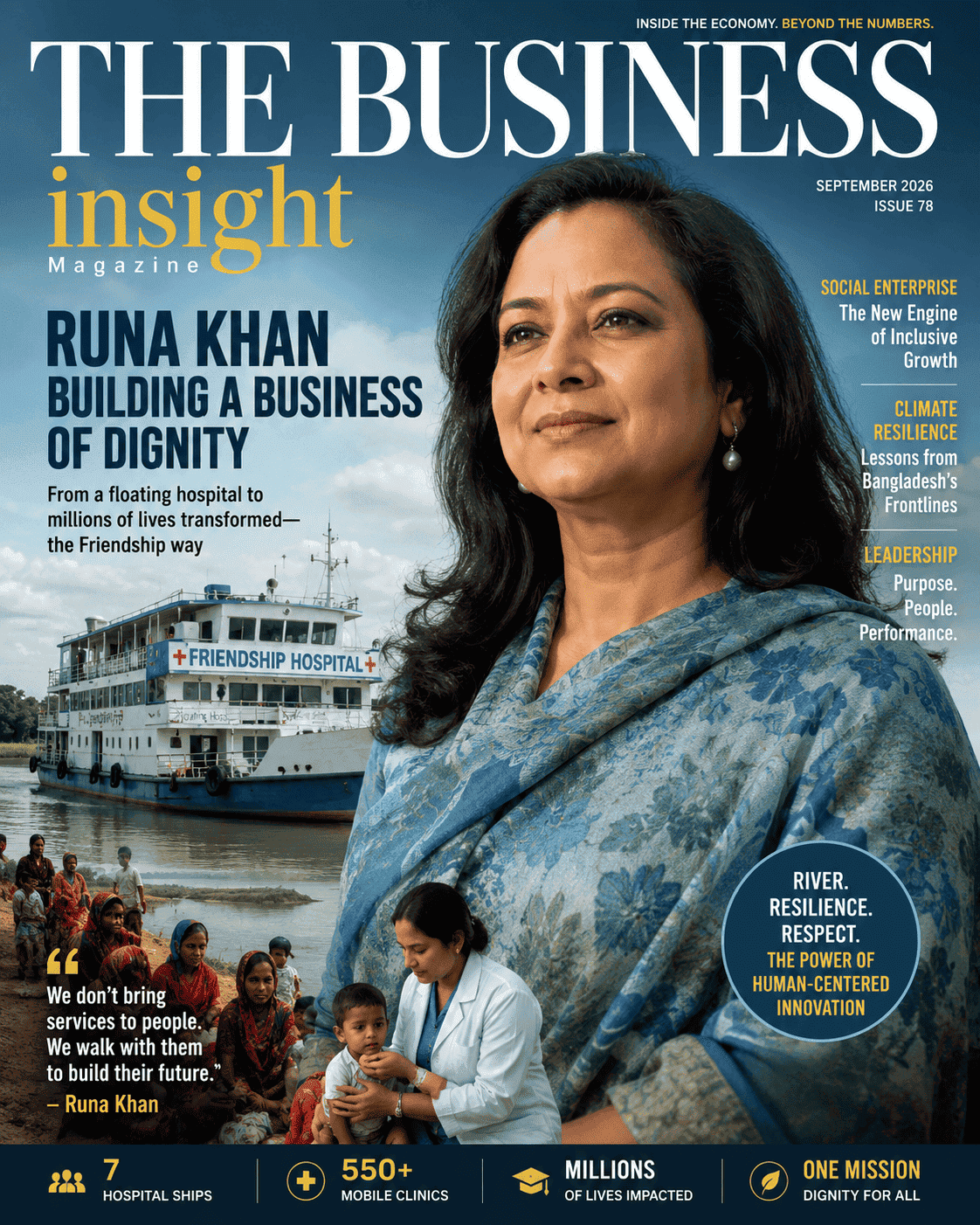
Runa Khan found an unconventional answer: if people cannot reach the hospital, take the hospital to the people.
That simple idea became the foundation of Friendship, the social-purpose organisation she established in 2002. What began with a floating hospital serving isolated communities has evolved into a multidimensional development operation spanning healthcare, education, climate adaptation, disaster management, economic opportunity and social inclusion.
More than two decades later, Khan has received one of Asia’s most prestigious honours, the 2026 Ramon Magsaysay Award.
The award recognises more than philanthropy. It acknowledges a model of leadership that combines compassion with execution, local knowledge with innovation, and social purpose with organisational scale.
For Bangladesh’s business community, that may be the most important part of Runa Khan’s story.
The Problem Came Before the Organisation
Many organisations begin with a structure and then search for problems to solve.
Friendship evolved in the opposite direction.
The problem was visible: some of Bangladesh’s poorest and most geographically isolated communities had little access to basic healthcare. Conventional infrastructure was difficult to sustain across constantly shifting river islands.
The solution therefore had to fit the environment.
A hospital ship did precisely that.
Instead of asking vulnerable communities to adapt to an established healthcare system, the system was redesigned around the realities of the communities themselves.
It was an early demonstration of what businesses today might call human-centred innovation.
But Khan did not stop at healthcare.
Experience in the field showed that illness could not be separated from poverty, education, employment, climate vulnerability, access to clean water or social rights.
Friendship consequently expanded into an integrated development model.
The lesson was straightforward: complex problems rarely have single-product solutions.
From One Floating Hospital to an Ecosystem
The scale that followed is striking.
According to the Ramon Magsaysay Award Foundation, Friendship today operates seven hospital ships, two land-based hospitals and around 550 mobile clinics. Its activities extend far beyond medical treatment.
The organisation works with communities facing some of Bangladesh’s harshest geographical and climatic conditions.
Its interventions include education, disaster preparedness, livelihood development, women’s empowerment, climate adaptation and access to essential services.
Friendship says its programmes now reach millions of people annually.
This transformation from one floating hospital into a broad social-development ecosystem offers an important management lesson.

Scale did not come from simply replicating the original product.
It came from understanding the underlying customer, or in this case community, more deeply.
Healthcare exposed educational needs. Poverty revealed livelihood constraints. Repeated natural disasters demanded resilience. Climate change required infrastructure designed for mobility and uncertainty.
The organisation expanded because the problem demanded expansion.
Innovation Under Constraint
Some of the most useful innovation emerges not from abundance, but scarcity.
Bangladesh’s river islands provide an extreme example.
Permanent buildings can disappear with erosion. Transport can be unreliable. Electricity may be unavailable. Medical specialists are often far away.
Friendship responded by designing around those constraints.
Floating hospitals brought healthcare through waterways. Mobile and satellite clinics extended the reach of medical services. Community members were trained to provide frontline support.
In climate-vulnerable areas, the same philosophy has influenced other interventions, including adaptable schools, water solutions and community-led environmental initiatives.
This is frugal innovation in its most practical form.
It asks a question relevant to every entrepreneur:
What if the limitation is not an obstacle to the business model, but the starting point for designing a better one?
Climate Adaptation Before It Became Fashionable
Today, almost every major corporation speaks about climate resilience and sustainability.
For communities along Bangladesh’s rivers and coastline, however, climate resilience is not an annual-report chapter.
It is survival.
Floods, river erosion, cyclones, salinity and displacement have already transformed livelihoods and communities.
Khan’s work therefore provides an important counterpoint to the way Bangladesh is frequently presented internationally.
Bangladesh is undoubtedly among the countries most exposed to climate risks. But it is also becoming a laboratory for practical adaptation.
Communities cannot wait for perfect infrastructure or distant technological breakthroughs.
They need solutions that work now.
Friendship’s experience demonstrates how local knowledge, decentralised service delivery and adaptable infrastructure can become part of that response.
For investors and businesses increasingly focused on climate finance, this experience has commercial as well as humanitarian relevance.
The next generation of climate solutions for emerging markets may not always emerge from laboratories in wealthy countries. Some will emerge from communities already living with the consequences.
Dignity as an Operating Principle
One word is central to Khan’s philosophy: dignity.
It is easy for development programmes to define poor people by what they lack.
Money. Education. Healthcare. Infrastructure. Opportunity.
Khan approaches the equation differently.
People living in poverty possess knowledge, resilience, aspirations and the ability to make decisions about their own lives. Development therefore cannot simply be something delivered to them.
It has to involve them.
This distinction may sound philosophical, but it has practical organisational consequences.
When beneficiaries become participants, solutions are more likely to reflect local reality. When communities have ownership, programmes have a greater chance of surviving beyond individual projects or funding cycles.
For business leaders, there is a parallel.
Companies often claim to be customer-centric while designing products far away from the people expected to use them.
Friendship’s approach suggests something more demanding: listen closely enough to understand not only what people say they need, but the constraints they may struggle to articulate.
That is as much a lesson in market intelligence as it is in development.
Leadership Without the Hero Narrative
Runa Khan grew up with privileges unavailable to many of the communities she would later serve.
Rather than denying that difference, her work has been shaped by a belief that privilege carries responsibility.
Her professional journey has not followed a conventional development-sector path. She has worked in education and entrepreneurship and has written books, while gradually building an organisation around the realities she encountered in the field.
That background matters.
Friendship was not built solely as a charity distributing assistance.
Its evolution required logistics, financing, recruitment, training, partnerships, technology, governance and continuous adaptation.
A hospital ship may begin as an inspiring idea.
Keeping it operating year after year is management.
Expanding from one service into an organisation capable of working across healthcare, education, climate resilience and economic development requires something more: institutional capacity.
That distinction is frequently lost when social entrepreneurs are celebrated only for their compassion.
Compassion may provide the purpose.
Execution creates the impact.
The Economics of Social Impact
There is another reason Khan’s story belongs in a business magazine.
Bangladesh’s development challenges increasingly intersect with its economic future.
Climate migration affects cities and labour markets. Poor healthcare reduces productivity. Lack of education limits human capital. Natural disasters destroy household assets and business infrastructure. Salinity affects agriculture. River erosion creates displacement and economic insecurity.
Addressing these problems is not separate from economic development.
It is part of economic development.
This is where the traditional boundary between business and social development is becoming less useful.
Governments cannot finance every solution. NGOs cannot solve every problem through grants. Businesses cannot remain insulated from the social and environmental systems in which they operate.
The emerging opportunity lies in partnerships that combine public responsibility, private capital, entrepreneurial execution and community knowledge.
Friendship offers one example of what such an ecosystem can look like.
A Bangladeshi Model With Global Relevance
The Ramon Magsaysay Award, established in 1958 and named after the former Philippine president, is widely regarded as one of Asia’s most respected honours for public service and transformative leadership.
Khan shares the 2026 recognition with Singaporean diplomat, lawyer and academic Tommy Koh and Myanmar human-rights activist and former political prisoner Bo Kyi.
The award ceremony is scheduled to take place in Manila on November 15.
Khan has received international recognition before. Her previous honours include the Rolex Award for Enterprise and recognition from the Schwab Foundation for Social Entrepreneurship, among others.
Yet the Magsaysay recognition arrives at an especially significant moment.
Climate resilience has moved to the centre of global economic debate. Investors are searching for credible impact models. Governments are struggling with the cost of adaptation. Businesses are being pushed to demonstrate measurable social value.
Bangladesh has something to contribute to each of those conversations.
Beyond the Award
Awards inevitably focus attention on individuals.
But the most compelling part of Runa Khan’s story remains far from an award ceremony.
It is on a river.
It is inside a mobile clinic.
It is in a coastal community looking for safe water.
It is in a school trying to continue teaching despite an environment that refuses to remain physically stable.
The business significance of her work lies precisely there.
Runa Khan has spent more than two decades demonstrating that some of society’s hardest problems can be approached with the same disciplines that create successful enterprises: understand the user, design around constraints, innovate continuously, build capable teams, measure what works and scale without losing sight of purpose.
There is also a deeper lesson.
Businesses traditionally measure value by what they create for shareholders and customers. The next generation of enterprises will increasingly be judged by a wider question: what kind of society exists because they operate in it?
Runa Khan’s answer began with a floating hospital.
It became an organisation.
Now it has become an internationally recognised Bangladeshi idea:
Impact can scale without sacrificing dignity.

- Md. Saiful Islam Journalisthttps://thebusinessin.com/author/saifuljournalist/

- Md. Saiful Islam Journalisthttps://thebusinessin.com/author/saifuljournalist/

- Md. Saiful Islam Journalisthttps://thebusinessin.com/author/saifuljournalist/
 October 23, 2026
- Md. Saiful Islam Journalisthttps://thebusinessin.com/author/saifuljournalist/
 September 9, 2026