Staff Correspondent, Dhaka
Published: September 29, 2025, 03:53 AM | Updated: September 30, 2025, 08:50 AM
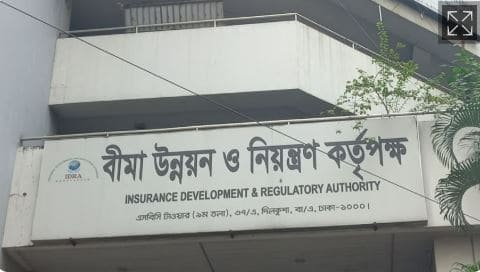
Insurance companies in Bangladesh are failing to settle policyholders’ claims on time, yet they show little restraint when it comes to their own spending. Despite cost-control guidelines set by the Insurance Development and Regulatory Authority (IDRA), firms continue to overshoot the ceiling. In 2024, a total of 42 insurers spent Tk 833 crore more than their permitted management expenses—much of which is suspected to have been siphoned off, according to industry insiders.
IDRA data shows that 20 life insurers overspent by Tk 159 crore and 22 general insurers by Tk 674 crore. The inflated expenses were shown under heads such as commissions, staff salaries, office rent, advertising, development meetings, vehicle purchase and repairs, foreign and domestic trips by top executives, fuel, entertainment, and even drivers’ allowances.
Industry insiders allege that company boards and senior management colluded to embezzle premium funds under the guise of “management expenses.” Several chairmen and CEOs have admitted to overspending, though they argue it was out of “necessity” rather than misuse.
Among life insurers, Fareast Islami Life Insurance Ltd topped the list with Tk 45 crore in excess spending. Its CEO Kamrul Hasan, newly appointed, admitted, “I’ve just joined recently, but I’ve heard irregularities took place here in the past.”
The state-run Jiban Bima Corporation followed with Tk 20.7 crore overspent, while Sonali Life Insurance (Tk 15.75 crore), NRB Islamic Life (Tk 11.42 crore), and Sunlife Insurance (Tk 9.08 crore) also reported significant extra costs.
On the non-life side, Global Insurance Ltd led the pack, overshooting its limit by Tk 115.14 crore. CEO Jamirul Islam bluntly said: “Yes, we spent beyond the government ceiling. What we reported is correct—reducing costs is simply impossible.”
Mercantile Islami Insurance came second with Tk 93.08 crore in excess spending, followed by Bangladesh Cooperative Insurance (Tk 91.53 crore), Islami Commercial Insurance (Tk 63.69 crore), and Desh General Insurance (Tk 43.01 crore).
Chartered Life’s former CEO and insurance expert S. M. Ziaul Haque said the problem stems from mismanagement and short-sightedness. Economist Dr. Mohammad Abdur Razzaque, chairman of think tank RAPID, echoed the concern, stressing the need for transparency and accountability.
Syed Shahriar Ahsan, CEO of Pioneer Insurance, said a robust audit system is essential: “If regular audits were enforced, these irregularities would not happen.”
According to the Insurance Act 2010 and related rules, 36 life insurers in 2024 were allowed to spend Tk 3,799.74 crore on management, but they reported Tk 3,852.63 crore—an overshoot of Tk 52.89 crore. Interestingly, 16 firms underspent by Tk 166 crore, with National Life Insurance alone saving Tk 90 crore.
Among life insurers that exceeded limits: Homeland Life (Tk 8.12 crore), Chartered Life (Tk 6.87 crore), Sunflower Life (Tk 6.11 crore), Padma Islami Life (Tk 5.59 crore), Golden Life (Tk 4.38 crore), Zenith Life (Tk 4.33 crore), Jamuna Life (Tk 4.02 crore), and several others.
In contrast, the 46 non-life insurers had a combined ceiling of Tk 1,576.85 crore but actually spent Tk 1,311.19 crore—an overall shortfall of Tk 265 crore, with 24 companies cutting costs. Still, 22 firms spent extravagantly, including Mercantile Islami, Bangladesh Cooperative, Islami Commercial, and Global Insurance, with overspending ratios ranging from 10% to over 115%.
Bangladesh Insurance Association director A. S. M. Nuruzzaman stressed that insurers must restore public trust by prioritizing claim payments over lavish spending: “This will enhance the industry’s image and help business grow with lower costs.”
Dhaka University’s Prof. Shahidul Islam Zahid, chair of Banking and Insurance, warned of three major crises facing the industry: ethical lapses, lack of data transparency, and weak regulation. “Unwarranted expenses are essentially looting customer funds. Unless IDRA strengthens oversight and acts against violators early, public confidence will collapse—posing even greater risks to the sector.”
IDRA spokesperson Saifun Nahar Sumi confirmed that fines were imposed on several firms in 2023 and warned that similar action awaits violators of 2024 as well.

- admin1@gmail.comhttps://thebusinessin.com/author/admin1gmail-com/

- admin1@gmail.comhttps://thebusinessin.com/author/admin1gmail-com/

- admin1@gmail.comhttps://thebusinessin.com/author/admin1gmail-com/

- admin1@gmail.comhttps://thebusinessin.com/author/admin1gmail-com/