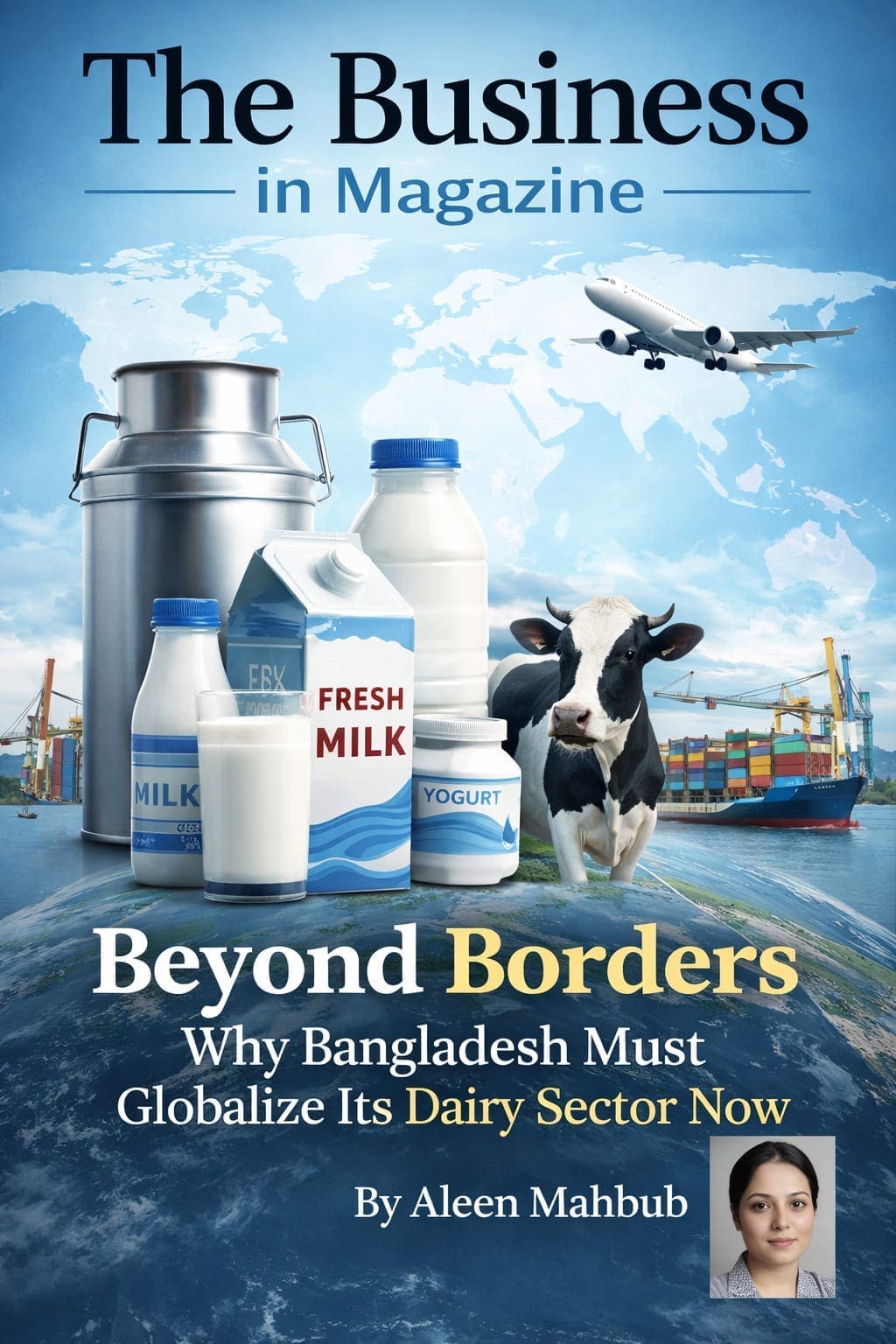
Aleen Mahbub
In Bangladesh, milk is more than a commodity.It is a quiet lifeline. It sustains rural households, fuels micro-enterprises, and connects thousands of smallholder farmers to a broader economic system. Yet, for all its social and economic significance, the country’s dairy sector remains largely confined within domestic boundaries. This is not just a missed opportunity; it is a strategic oversight.


At the center of this ecosystem stands Bangladesh Milk Producers’ Cooperative Union Ltd. (Milk Vita) a cooperative that has, for decades, demonstrated how decentralized production can be effectively aggregated, processed, and distributed. But the real question is no longer whether Bangladesh can produce dairy efficiently. The question is whether it can compete globally.The answer, increasingly, is yes but only if the country is willing to rethink its policy priorities and embrace a more export-oriented vision.
The global food market is changing. Consumers today are more curious, more mobile, and more open to diverse culinary experiences than ever before. This shift has fueled the rapid growth of the “ethnic food” segment, which now represents one of the most dynamic categories in international trade.
For Bangladesh, this trend presents a unique opening. Across the Middle East, Europe, and North America, millions of South Asians and an increasing number of global consumers are seeking authentic dairy products such as yogurt, ghee, and traditional sweets. These are not just nostalgic items for diaspora communities; they are becoming mainstream products in multicultural retail environments.
And yet, Bangladesh has barely scratched the surface of this market.Despite its production base and cultural richness, Bangladesh’s dairy sector faces several structural constraints that limit its global reach.
First, there is the issue of compliance. International markets, particularly in the European Union and North America, demand rigorous adherence to food safety standards such as HACCP and ISO certifications. For many small and medium enterprises (SMEs), these requirements remain out of reach not because they lack capability, but because they lack access to affordable certification infrastructure.
Second, the country suffers from a weak cold chain system. Dairy products are highly perishable, and without temperature-controlled logistics from collection to export terminalst the risk of spoilage becomes prohibitively high. This not only raises costs but also undermines buyer confidence.
Third, packaging remains outdated. In global trade, packaging is not merely a protective layer; it is a value proposition. Technologies such as aseptic packaging and vacuum sealing are essential for ensuring shelf life and maintaining product integrity during long-distance transportation. Their limited adoption in Bangladesh is a critical bottleneck.
Finally, there is a knowledge gap. Many SMEs are unfamiliar with export procedures, digital trade platforms, and international marketing strategies. As a result, even when opportunities exist, they remain inaccessible.
It would be inaccurate to say that Bangladesh lacks institutional support for SMEs. On the contrary, several organizations are already working to strengthen the sector.SME Foundation Bangladesh provides training and financial facilitation.Bangladesh Small and Cottage Industries Corporation (BSCIC) offers infrastructure and technical assistance.Export Promotion Bureau (EPB) connects exporters to global markets.Bangladesh Bank supports SMEs through refinance schemes and export incentives.Individually, these institutions are effective. But collectively, they operate in silos. What Bangladesh lacks is not capacity.It lacks coordination.
This is where the One District One Product (ODOP) framework becomes relevant. By encouraging each district to specialize in a particular product, ODOP creates a foundation for scale, branding, and competitiveness.
Applied to the dairy sector, the possibilities are compelling. Imagine Bogura emerging as a global hub for yogurt, Pabna for ghee, and Cumilla for traditional sweets. Such geographic specialization would not only streamline production but also create strong regional brands that resonate in international markets.
More importantly, ODOP can enable the development of Common Facility Centers (CFCs) shared spaces equipped with modern processing, testing, and packaging technologies. For SMEs, this would dramatically lower the barrier to entry into global trade.
Milk Vita’s cooperative model offers a ready-made foundation for scaling exports. With its extensive network of farmers and established processing capabilities, it can evolve into a central export hub.In such a model, SMEs would integrate into a structured value chain.
sourcing raw milk through cooperative networks,processing it using shared or private facilities,ensuring quality through centralized testing systems and marketing products under a unified, globally recognizable brand.This approach would not only enhance efficiency but also ensure consistency an essential requirement in international markets.
For this transformation to materialize, policy intervention is not optional.it is imperative.The government must introduce export guarantee schemes to reduce financial risk for SMEs entering global markets. Access to credit remains one of the biggest barriers to scaling production for export.
Investment in cold chain infrastructure is equally critical. Without it, even the highest-quality products cannot survive the journey from farm to foreign shelf.
There is also a need for digital traceability systems. In an era where consumers demand transparency, the ability to trace a product’s origin from farm to packaging can become a powerful differentiator. Technologies such as QR codes and blockchain can make this possible.
Equally important is the establishment of an SME Export Academy, where entrepreneurs can learn the technical, regulatory, and strategic aspects of global trade.
Finally, policymakers must recognize the role of women in the dairy sector. Targeted incentives and training programs for women entrepreneurs can unlock a powerful engine of inclusive growth.
dairy is deeply rooted in rural economies. Its growth has a direct impact on poverty reduction, employment generation, and food security. By turning dairy into an export-oriented industry, Bangladesh can achieve not just economic diversification, but also more inclusive development.
The global dairy market is becoming increasingly competitive. Countries like India, New Zealand, and the Netherlands have already established strong export positions. If Bangladesh delays its entry, it risks being permanently marginalized.But the cost of inaction is not just external.It is internal. Without access to larger markets, local producers will remain trapped in low-margin cycles, unable to scale or innovate.
Bangladesh is at a turning point where it can shift from treating dairy as just a local necessity to building it into a global business opportunity. With a foundation already in place—including the Milk Vita cooperative network, a growing sector of small and medium-sized enterprises, and existing institutional support—the country is well-positioned for growth. To achieve this, what is needed now is a clear vision, better coordination across the industry, and decisive government action to help the dairy sector thrive on the international stage.The world is ready for new flavors, new stories, and new sources of quality. Bangladesh has all three.The only question that remains is whether it is ready to step beyond its borders.
Writer : Aleen Mahbub is an Author focused on entrepreneurship, SME growth, and business insights.

- Md. Saiful Islam Journalisthttps://thebusinessin.com/author/saifuljournalist/

- Md. Saiful Islam Journalisthttps://thebusinessin.com/author/saifuljournalist/

- Md. Saiful Islam Journalisthttps://thebusinessin.com/author/saifuljournalist/

- Md. Saiful Islam Journalisthttps://thebusinessin.com/author/saifuljournalist/