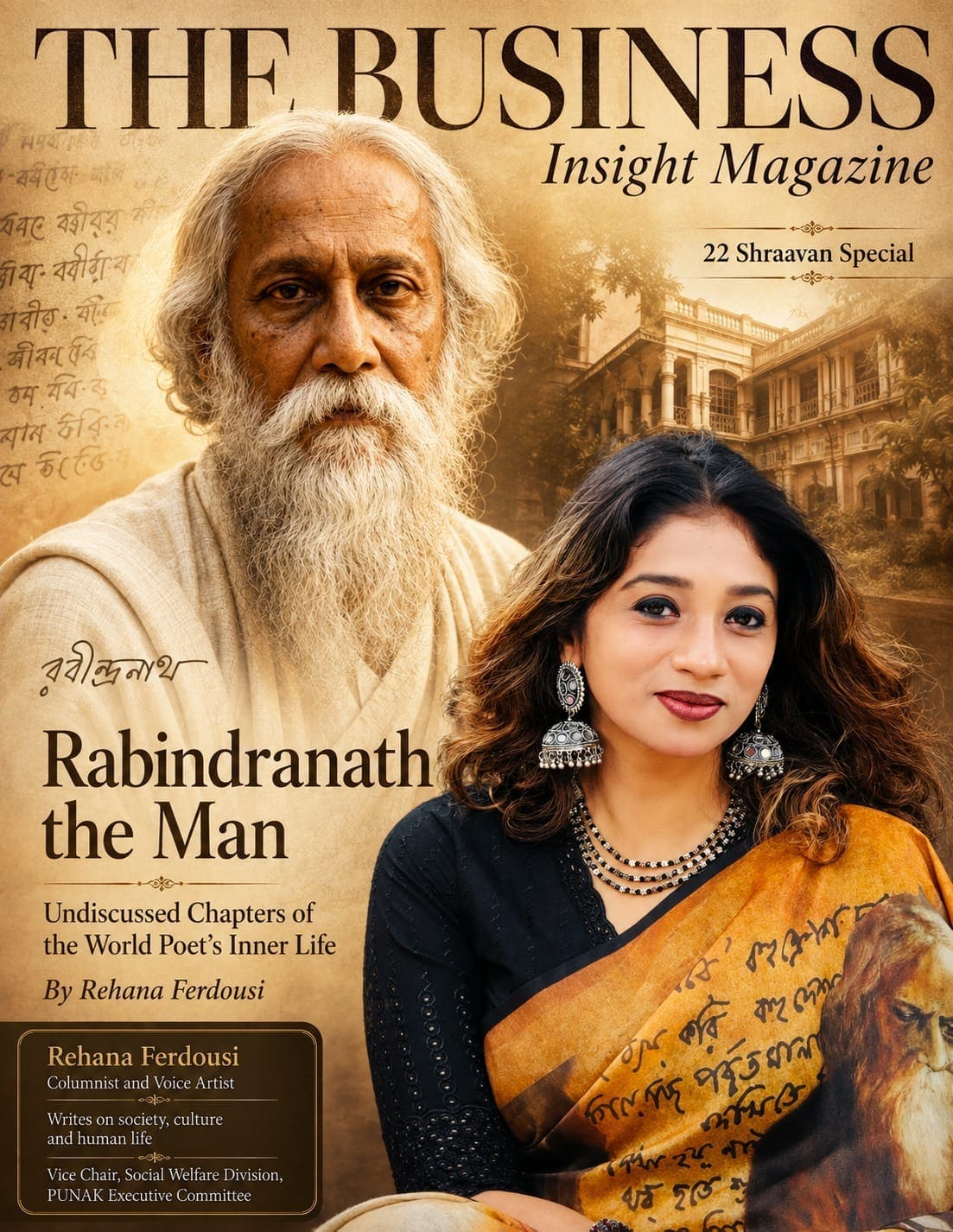
Rehana Ferdousi
The easiest way to know a person is not through his achievements alone; rather, it is to know how he loved, how he lost, and how he lived his private life.

As soon as 22 Shraavan arrives, the minds of Bengalis are enveloped in a different atmosphere. The melodies of Rabindra Sangeet are heard from all sides. His lines of poetry spread across social media. The literary pages of newspapers are filled with analyses of his life, philosophy and works. We remember with respect the Nobel laureate poet, the founder of Visva-Bharati, and one of the greatest writers of all time in the Bengali language.
But every year, amid this outpouring of respect, a question is silently lost: do we really remember Rabindranath, or just his fame? We read his poems, but we do not read the history of his tears. We sing his songs, but we do not hear the sound of his silence. We research his literature, but we rarely discuss his world, his family, his personal struggles and his loneliness. Perhaps this is why “Rabindranath the World Poet” is still known to us, while “Rabindranath the Man” remains largely unknown.
A writer’s literature cannot be completely separated from his life. The words born from the pen have their roots in lived experience. Joy, love, separation, death, achievement and imperfection all come together to create the creative world of an artist. Rabindranath is no exception. To understand his literature, one does not have to read only Gitanjali, Gora or The Home and the World; one also has to know the person inside his home.
The man we respect as the “World Poet” was once a child in the Tagore family of Jorasanko. He grew up under the influence of his father and later lost that father too. He built a married life, and then lost his life partner prematurely and endured a long loneliness. He dreamed of a new kind of education for his children, yet he also bore the unbearable grief of a father who lost children during his lifetime.
The greatest truth of history is that no great person is separated from his human identity. Rather, the foundation of greatness is built upon human experience. Rabindranath’s life was like that too. As bright as the light of his creation is, the shadows of his personal life are equally deep. Among those shadows were the loneliness of childhood, family responsibilities, the tenderness of married life, the pain of losing loved ones, and a long coexistence with death. But the surprising thing is that he never kept that pain merely personal; he transformed his tears into the language of humanity. Therefore, when reading his writings, it often seems as if he did not speak only of himself; he wrote the language of the human heart.
We offer flowers and garlands and sing songs on the anniversary of his death. But perhaps very few people think that the man before whose portrait we stand also had a family. At the end of the day, he too returned home. He too knew waiting, anxiety, joy, imperfection and sighs. He was not only a Nobel Prize-winning poet. He was a husband. He was the father of five children. He was a son who grieved at the death of his father. He was a man who did not allow his personal wounds to remain mere complaints, but transformed them into creation. Perhaps this is why Rabindranath is still so close to us. Because he is not only great for his talent; he is great for his endurance, his humanity and his extraordinary ability to transform even the deepest personal pain into a resource for the world.
The Tagore household was not merely the residence of an aristocratic family; it was a shining centre of the nineteenth-century Bengali Renaissance. There was literary practice, music, drama, philosophy, discussion of social reform, and a free flow of religious and cultural thought. It was natural for a child growing up in such an environment to have the opportunity to see the world differently.
Rabindranath was one of the youngest children of Debendranath Tagore. Debendranath was one of the leading figures of the Brahmo movement, a spiritual, disciplined and profound thinker. Rabindranath’s mother, Sarada Devi, on the other hand, was a quiet presence at the centre of the family. But because of the size and demands of the household, Rabindranath did not get much time with his mother during childhood. Her death during his adolescence created a silent void in his life.
The family had many members. Some of his elder brothers and sisters were philosophers, some writers, some musicians, some artists, and some social reformers. Dwijendranath Tagore was a scholar and philosopher, Satyendranath Tagore was the first Indian to join the Indian Civil Service, and Jyotirindranath Tagore was a playwright, musician and one of the leading cultural figures of his time. This multifaceted environment deeply influenced Rabindranath’s artistic nature.
Yet even in this privileged environment, his childhood was not entirely happy. Because of the rules and restrictions of the huge household, the strictness of tutors and the busyness of his guardians, he often felt lonely. Later, in his memoir Jibansmriti, various hints of that childhood loneliness can be found. That loneliness may have led him towards nature, immersed him in the world of imagination and forged his lifelong friendship with words.
Debendranath Tagore did not merely teach his son; he gave him the eyes with which to see nature. A journey with his father in 1873, which included Santiniketan and the Himalayan region, became an important turning point in Rabindranath’s life. Amid mountains, sky, forests, stars and silence, he experienced the vastness of nature in a new way. The seeds of the deep presence of nature later seen in his poetry, songs and philosophy were planted through such experiences.
However, another lesson of the Tagore family was equally important: respect for human beings. The liberal outlook that repeatedly returns in Rabindranath’s writings, looking at people beyond religion, caste, language or geographical identity, can also be traced to his family environment. That is why he is deeply Bengali on the one hand and a voice of universal humanity on the other.
For him, family was not merely a bond of blood; it was a school of values. From there he learned discipline, artistic consciousness, humanity, self-criticism and the courage to think independently. This education later took shape in the educational philosophy of Santiniketan, where nature, creativity and free thinking were given importance instead of rote learning.
Perhaps this is why Rabindranath’s literature is so deeply human. Because he did not learn only from books; he learned from life, from family, from relationships and from silence.
On 9 December 1883, at the age of only twenty-two, Rabindranath married Bhavatarini Devi. After marriage, she came to be known as Mrinalini Devi. Although the marriage was arranged according to the social customs of the time, over the years their relationship developed through responsibility, family life and companionship.
Mrinalini Devi silently carried a large part of the burden of the household that stood behind Rabindranath’s literary pursuits, estate responsibilities and multifaceted work. Her name is not mentioned much in history. She was neither a writer nor a public leader. Yet when writing the history of Rabindranath’s life, it is impossible to ignore her. Because often some of the greatest contributions to the lives of great people are made by those who never come into the limelight.
During their married life, five children were born to them: Madhurilata, known as Bela; Rathindranath; Renuka; Mira; and Shamindranath.
As a father, Rabindranath was affectionate, but not a strict guardian in the conventional sense. He believed that a child’s mind should be given the opportunity to develop, not merely be subjected to discipline. An introduction to nature, artistic practice, independent thinking and the courage to ask questions were among the foundations of his educational philosophy. Later, that belief became a reality in the education system of Santiniketan.
But fate had written a different story for his family.
In 1902, Mrinalini Devi died at the age of about twenty-nine. The person who had quietly stood beside him in his domestic life suddenly departed. This death was not merely the death of a wife; it created one of the deepest voids in Rabindranath’s personal life.
Before he could fully overcome that grief, his daughter Renuka died in 1903. Then came the death of his father, Debendranath Tagore, in 1905. The untimely death of his younger son Shamindranath followed in 1907. Later, in 1918, the death of his eldest daughter Madhurilata also deeply affected him.
Losing so many loved ones over the years could have broken any person.
But here lies one of the most remarkable aspects of Rabindranath’s life. He did not deny grief, nor did he surrender to it. He did not allow personal grief to remain merely personal lament. Rather, that grief gradually took shape in his poems, songs, essays and philosophy.
In his writings, death is never just an end; sometimes it is transformation, sometimes a longing for union even in separation, sometimes a deeper understanding of life.
One thing becomes clear when reading Rabindranath’s letters: his affection for his family was genuine. Even amid his busy life, he thought deeply about the education, character and mental development of his children. For him, fatherhood was not merely guardianship; it was the responsibility of helping to build a human being.
Today, when we define success, we often overlook a person’s family identity. But Rabindranath’s life teaches us another lesson. A person can be a world-class writer, social thinker, educationist and devoted family man at the same time. These identities are not rivals; rather, they enrich one another.
Rabindranath’s literature is not merely an exercise in aesthetics; it is also a document of a philosophy of life. In his poetry, death is not only a symbol of fear, but the acceptance of an inevitable truth. In his songs, separation is not merely pain, but a deep dialogue of the soul. In his essays, human beings are not bound by the borders of any nation, religion or territory; they are part of universal humanity.
That is why, when reading Gitanjali, it sometimes seems that the poet is not only speaking to God; he is also speaking from the depths of his own wounded heart. Just as a child’s mind dreams of liberation in The Post Office, a spiritual longing to overcome the limitations of life is also expressed there. In many of his songs and poems, grief becomes universal rather than remaining personal. Personal experience is no longer his alone; it becomes the language of human feeling.
Rabindranath’s life teaches us another profound lesson: greatness is never built by talent alone; character, endurance and humanity complete it.
The Nobel Prize in Literature in 1913 brought his name unprecedented recognition on the world stage, although his international reputation had already begun to grow through the English Gitanjali and the interest of literary figures such as W. B. Yeats. But it was his humanity, as much as his genius, that made his work endure.
Because his literature does not teach the division of people; it teaches connection. He took up his pen against narrowness, prejudice and blind nationalism, and in favour of human dignity.
As today’s world advances in technology, loneliness, fear, isolation and crises of values within human beings are becoming more pronounced. At this time, there is a need to read Rabindranath anew.
He showed that personal loss does not have to make a person cruel. Deep grief can also make a person more compassionate, more generous and more creative. He demonstrated that the highest expression of talent is achieved when it is connected with human welfare.
Perhaps this is why Rabindranath is not only Bengali; he is universal. His identity is not confined to a single language, nation or territory. He is a writer in whose words people from different parts of the world find echoes of their own lives.
At the beginning of this writing, there was a question: do we remember Rabindranath, or only his fame?
Now the answer may be clearer.
Because no one is born a World Poet. He becomes one through a long journey of life, experience, struggle, loss and creation.
On 22 Shraavan, therefore, our respect is not only for his literature, but also for the man behind it. His pen became immortal through words, but those words were born from the deepest experiences of life.
The time has come to read Rabindranath anew, not only through his poetry, but through the man himself.
The name of that man is Rabindranath Tagore.
Author Biography
Rehana Ferdouse is a columnist, analytical writer, and voice artist from Bangladesh. She regularly contributes to leading national newspapers and periodicals, writing on society, culture, economics, public life, and contemporary social issues. She earned both her Bachelor’s and Master’s degrees in Economics with First Class distinction from Eden Mohila College. Her work is characterized by evidence-based analysis, critical thinking, and a balanced approach to issues of public interest. In addition to her writing, she is recognized for her contributions as a voice artist in recitation and documentary narration. She currently serves as the Vice Chairperson of the Social Welfare Department of the Executive Committee of the Central Police Women’s Welfare Association (PUNAK), where she actively supports initiatives related to women’s empowerment, social welfare, and community development.

- Md. Saiful Islam Journalisthttps://thebusinessin.com/author/saifuljournalist/

- Md. Saiful Islam Journalisthttps://thebusinessin.com/author/saifuljournalist/

- Md. Saiful Islam Journalisthttps://thebusinessin.com/author/saifuljournalist/

- Md. Saiful Islam Journalisthttps://thebusinessin.com/author/saifuljournalist/