By Ali Kodar Polash
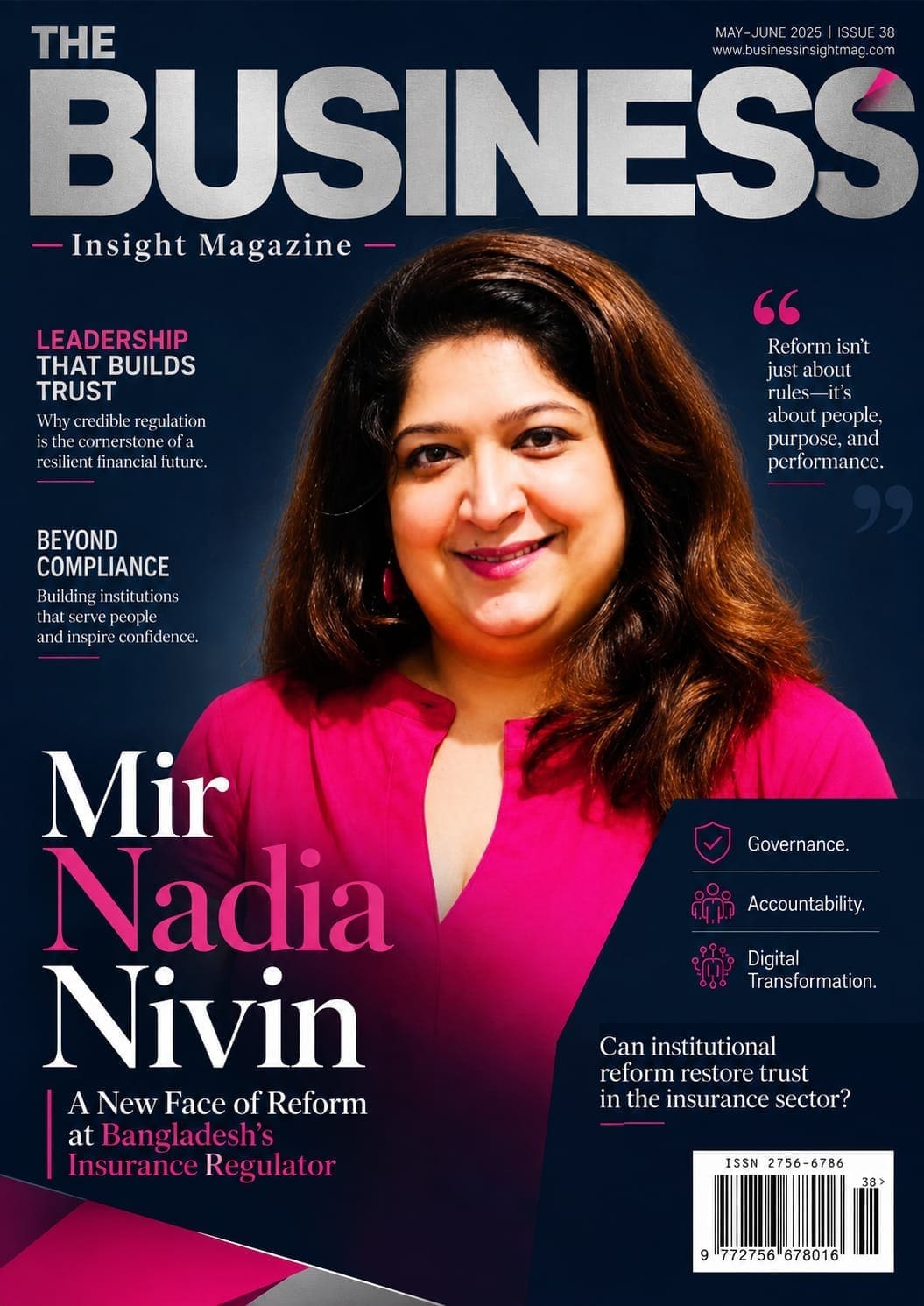
From Harvard to the United Nations: Mir Nadia Nivin Brings a Different Kind of Leadership to Bangladesh’s Insurance Sector
Leadership changes at Bangladesh’s insurance regulator rarely become a subject of national discussion. Banking crises make headlines. Stock market turbulence attracts immediate attention. Insurance, by contrast, usually remains within professional circles.
Yet the government’s decision on 16 June to appoint Mir Nadia Nivin as Chairman of the Insurance Development and Regulatory Authority of Bangladesh, or IDRA, has generated unusual interest.
The reason is not simply that she is the first woman to lead the authority. What makes her appointment more significant is the professional background she brings to the job.
Bangladesh’s financial regulators have traditionally been headed by bankers, insurance professionals, senior bureaucrats or people with long experience in finance. Nivin comes from a different world.
She is primarily a specialist in governance, institutional reform and digital transformation. Nearly two decades of her career were spent with the United Nations Development Programme, where she worked across Bangladesh, Afghanistan, Pakistan, Malaysia and Myanmar. Her assignments involved electoral governance, democratic institutions, administrative efficiency, accountability and institutional capacity-building.
Insurance, however, is not entirely unfamiliar territory.
Before taking charge of IDRA, she served as an independent director of Delta Life Insurance Company Limited, one of Bangladesh’s established life insurers. That role gave her direct exposure to the realities of corporate governance and management within the country’s insurance industry.
It is this combination that makes her appointment unusual: extensive international experience in governance and reform, alongside first-hand familiarity with Bangladesh’s insurance sector.
The question now is whether that combination can help restore confidence in an industry struggling with trust.
An Industry in Need of Confidence
In insurance, the most valuable asset is not capital. It is trust.
When a person buys a life insurance policy, they are purchasing a promise about the future. When a business takes out insurance, it is seeking protection against uncertainty. Both depend on confidence that the promise will be honoured.
Once that confidence weakens, the entire system becomes vulnerable.
Bangladesh’s insurance sector has faced persistent criticism over delays in claim settlements, weak corporate governance, customer complaints, limited technological progress and low market penetration.
Economists have often pointed out that while the broader economy expanded, insurance did not grow at the same pace. Industry insiders, meanwhile, argue that the market still holds enormous potential—if confidence and governance can be strengthened.
Against this background, Nivin’s appointment is being seen by some as more than a routine change of leadership. It may represent an attempt to redefine the problem itself.
Rather than viewing insurance merely as a commercial sector requiring financial supervision, the government appears to be placing greater emphasis on institutional capacity, governance and public confidence.
These are precisely the areas around which much of Nivin’s career has revolved.

From Kuwait to Harvard
Mir Nadia Nivin was born in Kuwait and spent part of her childhood there before returning to Bangladesh with her family.
She later travelled to the United States for higher education. After completing postgraduate studies at California State University, Sacramento, she pursued advanced studies in public administration at Harvard University.
Her years at Harvard helped shape the direction of her later career. Questions of how states function, why institutions fail, how accountability can be strengthened and how public services can become more effective moved to the centre of her professional interests.
Much of the next two decades would be spent working on precisely those issues.
The United Nations Years
Nivin joined the United Nations Development Programme in 2007, and her responsibilities gradually became international in scope.
At one stage, she worked with UNDP’s Global Elections Team in New York, contributing to programmes aimed at improving electoral systems, strengthening democratic institutions and building administrative capacity in different countries.
At first glance, that experience may seem distant from insurance regulation. But the underlying principle is similar.
Whether it is an election commission, a parliament, a regulator or an insurance company, institutional effectiveness ultimately depends on confidence.
Rules matter. Laws matter. Technology matters. But if people no longer trust an institution, technical reform alone cannot restore legitimacy.
That lesson became a recurring theme in her career.
Lessons from Afghanistan
Her work in Afghanistan became one of the defining chapters of her professional life.
In a conflict-affected country, she became involved in electoral institutions, parliamentary processes, public financial management, local governance and women’s participation.
Afghanistan offered a stark lesson in institutional fragility. She saw what happens when confidence in public institutions breaks down—and how difficult it is to reconnect citizens with systems they no longer believe in.
The experience reinforced a central idea: development is not only about roads, bridges or infrastructure. It is also about building institutions that work.
For Bangladesh’s insurance industry, that lesson is particularly relevant.
An insurance market cannot grow sustainably merely by selling more policies. The institutions behind those policies must also function credibly.
Pakistan, Malaysia and Reform
Nivin later worked in Pakistan’s former Federally Administered Tribal Areas and in Khyber Pakhtunkhwa, where she was involved in programmes concerning displaced communities, rehabilitation and social reconstruction.
Malaysia added another dimension to her experience.
There, she worked with reform initiatives involving the Election Commission, Parliament, the Prime Minister’s Office and anti-corruption programmes. She was also engaged in work linked to implementation of the Sustainable Development Goals.
Malaysia gave her exposure to a model in which administrative reform, technology and accountability intersect.
That experience has obvious relevance at a time when Bangladesh’s insurance industry is confronting questions not only about regulation, but also about transparency and digital transformation.
The Digital Transformation Advantage
Between 2020 and 2023, Nivin was involved in leadership roles connected with UNDP’s strategic management and digital transformation initiatives.
The focus was on using technology to make institutions more efficient, transparent and responsive.
This could prove especially valuable at IDRA.
Across the world, insurance is becoming increasingly digital. Online policy management, automated premium tracking, digital claims processing, data-driven risk assessment and integrated customer databases are now part of modern insurance infrastructure.
Bangladesh has made progress, but major gaps remain.
For IDRA, the real test will not simply be whether more services become digital. It will be whether technology makes it easier to track policies, resolve claims, detect irregularities and protect customers.
Returning to Bangladesh’s Reform Agenda
After years of international assignments, Mir Nadia Nivin became more visible in Bangladesh’s public policy arena through her role as a member of the Election System Reform Commission.
The commission was tasked with reviewing the country’s electoral arrangements and recommending reforms.
Her writings and public positions reflected a consistent belief: sustainable progress depends less on individuals than on institutions.
Strong personalities may lead institutions for a time. Strong institutions survive beyond personalities.
That philosophy may now face its most practical test at IDRA.

Five Challenges Before the New Chairman
The significance of Nivin’s appointment will ultimately depend on what happens inside Bangladesh’s insurance sector, not on the strength of her résumé.
Five challenges stand out.
The first is restoring public confidence. Unresolved claims and prolonged delays damage not only individual insurers, but the credibility of the industry itself.
The second is corporate governance. Boards, management teams, ownership structures and regulatory oversight must operate within clear lines of responsibility.
The third is digital transformation. Bangladesh needs a more integrated insurance ecosystem in which policies, premiums, claims and customer records can be monitored efficiently and transparently.
The fourth is customer protection. A modern regulator must make it easier for policyholders to understand products, lodge complaints, track claims and receive timely decisions.
The fifth is regulatory modernisation. Bangladesh’s insurance framework will increasingly need to align with internationally accepted standards in risk management, solvency supervision, governance and consumer protection.
What makes these challenges particularly interesting is that each connects, in one way or another, with Nivin’s previous professional experience.
Why a Governance Specialist?
The appointment of Mir Nadia Nivin can be interpreted in different ways.
Some will see her simply as a new face. Others may regard the choice as a signal of a new regulatory philosophy.
But one conclusion is difficult to avoid.
The government appears to be treating the problems of the insurance industry as more than purely commercial or financial problems. They are also problems of institutional capacity, governance, accountability and public confidence.
That may explain why a conventional insurance executive was not chosen to lead the regulator.
Instead, the responsibility has gone to someone whose career has largely been devoted to one central question: how can institutions become stronger, more transparent and more trusted?
Her credentials are substantial. Harvard, a long career with the United Nations, and experience across complex political and administrative environments from Afghanistan to Malaysia give her an unusually broad perspective.
But credentials alone will not determine the success of her tenure.
The real measure will be simpler.
Can policyholders receive legitimate claims without unreasonable delay? Can poorly governed insurers be held accountable? Can technology make the industry more transparent? Can IDRA act before crises deepen rather than after the damage has been done?
Most importantly, can ordinary Bangladeshis begin to trust insurance again?
Those questions will define Mir Nadia Nivin’s tenure.
In the end, history will not judge the appointment by how unconventional it appeared in June. It will judge it by whether bringing a governance specialist to IDRA helped turn governance into confidence—and confidence into a stronger insurance industry.

- Md. Saiful Islam Journalisthttps://thebusinessin.com/author/saifuljournalist/

- Md. Saiful Islam Journalisthttps://thebusinessin.com/author/saifuljournalist/

- Md. Saiful Islam Journalisthttps://thebusinessin.com/author/saifuljournalist/

- Md. Saiful Islam Journalisthttps://thebusinessin.com/author/saifuljournalist/