By [Ali Kodar Polash (আলী কদর পলাশ)] | Dhaka | 15 November 2025
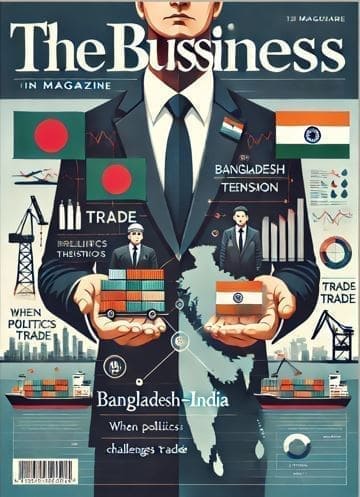
As Bangladesh awaits a historic verdict in the war crimes case against former Prime Minister Sheikh Hasina, the ripple effects are beginning to stretch well beyond the courtroom. In recent days, a series of media interviews granted by Hasina—now in political exile in India—has ignited a fresh wave of diplomatic unease between Dhaka and New Delhi. Now, that unease is creeping into the one arena both countries have long tried to shield from political turbulence: trade.
Earlier this month, Bangladesh’s International Crimes Tribunal announced 30 November 2025 as the date it will deliver its verdict in the case against Hasina. Prosecutors accuse her of overseeing systematic extrajudicial killings, enforced disappearances, political persecution, and torture between 2018 and 2023, classifying them as crimes against humanity. They are seeking the maximum penalty—death.
In a swift and deliberate counter-offensive, Hasina has emerged in the international press with a steady stream of interviews—primarily with Indian and Western media outlets—denying all allegations and framing her ouster as the product of foreign interference, particularly from the United States. She has also criticized the interim Bangladeshi administration, calling it illegitimate and elite-controlled. Her statements have garnered headlines, but also stirred visible discomfort in Dhaka’s diplomatic circles, particularly because of her continued visibility in Indian media.
For the first time since her fall from power, political tensions have crossed into the trade domain. Bangladesh summoned India’s Deputy High Commissioner in Dhaka on 12 November to formally express concern over what it described as India’s apparent facilitation of a media platform for a fugitive under trial. The fallout, say analysts, is no longer symbolic.
Behind closed doors, Bangladesh’s Ministry of Foreign Affairs and Economic Relations Division has launched a risk assessment exercise, evaluating whether bilateral trade—valued at $14 billion annually—may be impacted. India accounts for over $10.7 billion of exports to Bangladesh, while Bangladesh’s exports remain under $2 billion. The imbalance has long been a topic of negotiation, but has never seriously disrupted economic engagement. Until now.
“There’s a real possibility that this political chill will translate into procedural delays at land ports and customs,” says a senior official involved in trade policy, speaking on condition of anonymity. “The dependence on Indian imports is significant—particularly for food, medicine, and industrial raw materials. Any bottleneck can quickly cascade into market volatility.”

Former Commerce Secretary Farooq Hossain warns that,
“In times of political friction, even routine port operations slow down. Customs officers get cautious. This isn’t about sanctions—it’s about a shift in behavior that impacts supply chains.”
Mohammad Salahuddin, President of the Bangladesh–India Chamber of Commerce and Industry (BIBCCI), adds:
“We’ve always tried to insulate trade from politics. But when diplomatic sentiment sours, the private sector inevitably feels it.”
The stakes are especially high for Indian investment in Bangladesh, which has grown in sectors like power, pharmaceuticals, telecom, and e-commerce. Several joint ventures could face delays, renegotiations, or quiet exits if the atmosphere continues to deteriorate.
International observers say Indian trade bodies like FICCI and CII have flagged “political risk exposure” in Bangladesh in recent internal memos—a rare move signaling private-sector caution.
The awkward optics have also reached Delhi. On one hand, India has offered sanctuary to Hasina, a figure it long supported. On the other, her growing visibility—particularly on Indian media platforms—is drawing scrutiny both at home and abroad, especially in light of the gravity of the charges she faces.
Political analyst Tanvir Hassan notes:
“Trade thrives on trust. If the Hasina controversy begins to polarize opinion inside India itself, the pressure to respond—whether through policy or perception—could quickly escalate.”
In Dhaka’s wholesale markets, importers are already uneasy.
“All it takes is one consignment of onions stuck at the border, and prices double overnight,” says a Shyambazar trader. “It’s happened before.”
So far, no official embargoes or suspensions have been announced. Both governments publicly maintain that trade will continue uninterrupted. But in the shadows, traders and freight operators are bracing for slower clearances, document backlogs, or shifts in customs attitude—all of which can stall movement at the borders.
Experts are urging both nations to activate backchannel diplomacy and de-escalate tensions before they reach the point of economic friction. Many are also calling for a clearer separation between political proceedings and economic cooperation, particularly in a region where trade interdependence is crucial for stability.
Bangladesh and India operate six land ports and multiple border trade routes, through which essential goods pass daily. A single misstep—be it a political remark or procedural change—can disrupt this flow. For Bangladesh’s import-heavy economy, such turbulence could translate into rapid inflation and market shocks.
The message is clear: the courtroom verdict may be political, but its consequences are economic. Unless both sides act with restraint, the economic fallout from this geopolitical episode could extend far beyond Hasina—and well into the shelves, trucks, and ports that keep the region running.

- admin1@gmail.comhttps://thebusinessin.com/author/admin1gmail-com/

- admin1@gmail.comhttps://thebusinessin.com/author/admin1gmail-com/

- admin1@gmail.comhttps://thebusinessin.com/author/admin1gmail-com/

- admin1@gmail.comhttps://thebusinessin.com/author/admin1gmail-com/