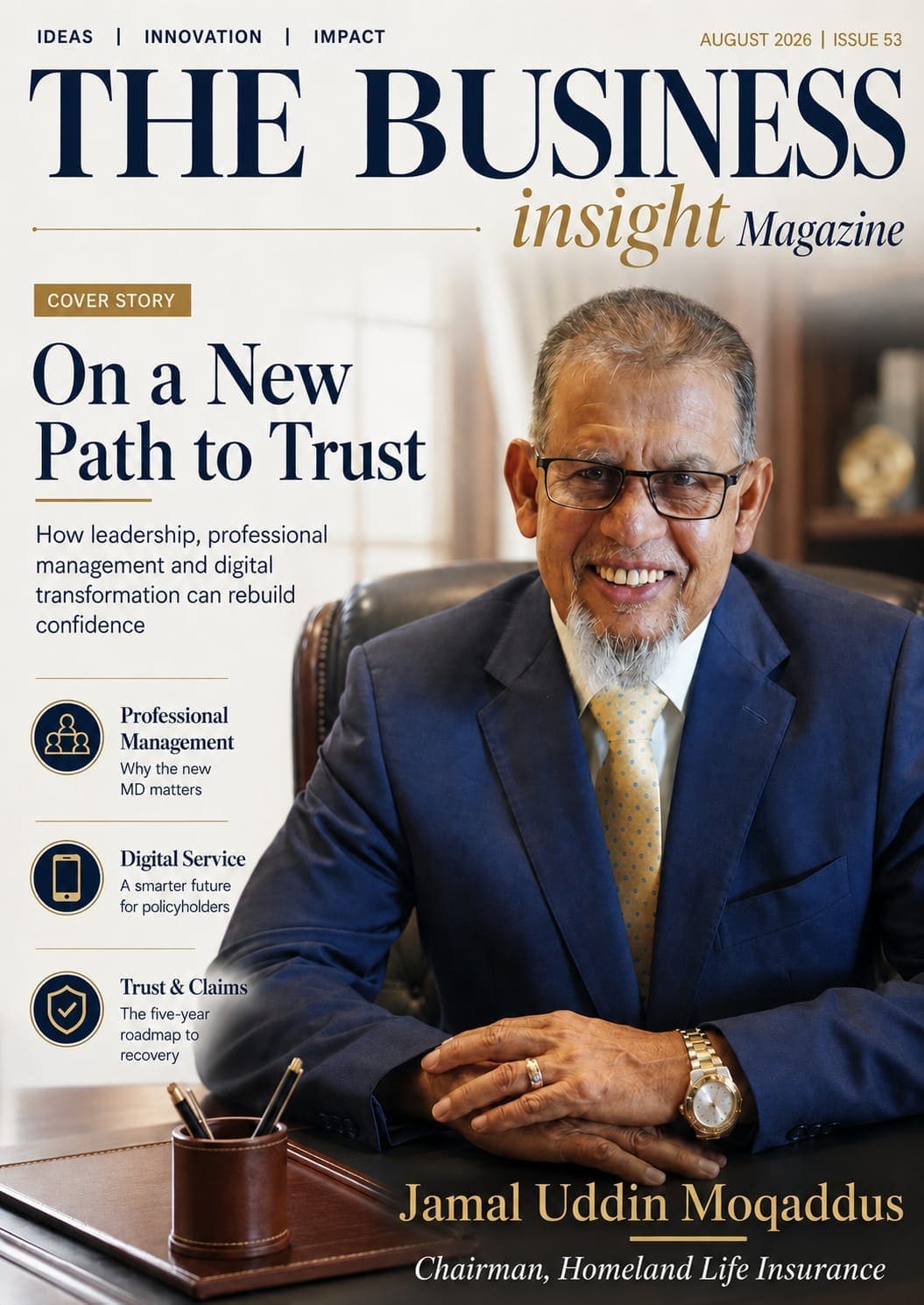
By Ali Kodar Polash
Chairman Jamal Uddin outlines a five-year plan focused on settling policyholders’ claims, digital transformation and professional management
What is the greatest asset of a successful businessman—money, an institution, or people’s trust?
Jamal Uddin Moqaddus did not need much time to answer.
“People’s trust.”
He has spent more than five decades in business. He has made profits and suffered losses. He has invested in the stock market, earned money and lost money. As a young man, he left Bangladesh for London, where he gradually built himself into an established businessman.
Now approaching seventy, he still speaks less about retirement than about learning.
“I still want to learn.”
That perhaps explains why a conversation with the current Chairman of Homeland Life Insurance Company cannot begin with insurance alone. His story is also about migration, enterprise, setbacks, ambition, attachment to Bangladesh—and, ultimately, the difficult task of rebuilding an institution that once carried promise but later became burdened by disputes, financial distress and uncertainty among policyholders.
Today, Jamal Uddin says he wants to leave that past behind and begin again.
And he knows that the first test of any new beginning will be simple but demanding: restoring the trust of policyholders.
From Bangladesh to London
Jamal Uddin began his business career in Bangladesh. After spending about four years in business here, he decided to move to London.
It was not an easy journey. No member of his immediate family was living there at the time. There was no ready-made network or familiar support system waiting for him. What he had instead was the desire to explore a larger world and build a place for himself through his own effort.
Looking back, he considers that decision one of the major turning points of his life.
In London, he gradually established himself in business. Over the decades, he learned not only how to make money, but also how institutions survive, why discipline matters, how customers must be treated, and how fragile trust can become once it is broken.
He says he now has 56 years of business experience—and wants to bring all of it to Homeland Life.

“Whatever experience I have gained in my life, I want to use it here.”
For him, money is essential to building an institution. But money alone cannot make an institution last.
“Money is important. You need money to build an institution. But without honesty, you cannot build anything.”
That theme—honesty, trust and accountability—returned repeatedly throughout the conversation.
Losses, lessons and the instinct to begin again
Asked about the hardest period of his life, Jamal Uddin did not identify a single crisis.
Instead, he said he had never allowed himself to think of any period as impossible.
“If I had thought everything was too difficult, I would not have reached this point. There were obstacles. I suffered losses in business. But I overcame them.”
His experience in the stock market was part of that education. He earned money there and lost money there. Yet he does not regard losses merely as failures. He sees them as lessons.
That may also explain why, even at nearly seventy, he still speaks of learning as an unfinished process.
And now he wants to apply those lessons to one of the most challenging chapters of his business life—Homeland Life.
A bond with Bangladesh that never faded
Years abroad never severed Jamal Uddin’s connection with Bangladesh.
He has continued to invest in his home area and speaks with particular emotion about an educational institution he established there. The school has been running for about 27 years, and for roughly 22 of those years, he says, it was supported largely through his own funding.
Today, Jamal Uddin High School is a recognised institution in the locality.
When he speaks about it, the businessman gives way to the man.
“The way people in my area appreciate me makes me feel that my life has been blessed.”
He says the same sense of responsibility toward Bangladesh helped inspire his involvement with Homeland Life in the first place.
When the company was launched in 1996, Bangladesh was a poorer country. The idea, he recalls, was to create an institution that could contribute to employment, savings and economic participation.
But the journey did not unfold as planned.
“We did not understand the insurance sector well enough”
Asked why he remains so deeply involved with Homeland Life, Jamal Uddin offered an unusually candid answer.
He said the expatriate entrepreneurs involved with the company did not have enough experience in the insurance sector.
They had capital, good intentions and a desire to contribute to the country, but managing a specialised financial institution from abroad proved far more complicated.
Over time, weak oversight, management failures and disagreements among directors pushed the company into serious difficulties.
At one stage, Jamal Uddin says, he realised how badly the institution had been damaged.
He then faced a choice: walk away or stay and fight.
Some colleagues advised him to leave.
He refused.

“People told me to leave it and walk away. But nobody could stop me. I did not leave, and I will not leave.”
There is more than business calculation in that statement. There is also pride, responsibility and determination.
The biggest problem is financial
When asked to identify Homeland Life’s biggest current challenge, the Chairman did not avoid the issue.
His answer was direct: financial distress.
The company has suffered major financial losses. Policyholder claims remain unpaid. Delays in settling claims have damaged the company’s reputation and, more importantly, weakened public confidence.
Yet Jamal Uddin insists the crisis is not beyond repair.
He believes that with competent management, strong field operations, professional recruitment and unity among directors, Homeland Life can recover.
“If I can organise the company properly and recruit good people, Inshallah, this company will rise again.”
He identifies Homeland Life’s field force as one of its key strengths.
But he also believes that the field force can only perform effectively if it is backed by a disciplined and professional administration.
“If we can establish a good administration, there will be no major obstacle.”
As for the company’s weaknesses, he says many have already been addressed. But he acknowledges that disagreements among directors were once a serious problem.
For now, he says, that situation has improved.
“We are together now. We are moving forward together.”
Settling old claims is the first real test
The first test of Homeland Life’s recovery is not a new office, a new product or a marketing campaign.
It is the money owed to existing policyholders.
In 2023, reports indicated that more than 37,000 policyholders had unsettled claims, with outstanding claims amounting to around Tk 79 crore.
Jamal Uddin acknowledges that the problem has not disappeared overnight.
He says some progress has been made. During the three months of the interim board, approximately Tk 1.5 crore in claims was paid, while additional payments had been made earlier as well.
However, he was unable during the interview to provide an exact current figure for total outstanding claims.
Nor did he offer a fixed date by which every valid claim would be settled.
“I cannot give an exact date. But we will settle them as quickly as we can.”
Still, he referred to two timelines.
He expects policyholders to begin seeing visible change within six months.
And over the longer term, he has set a much more ambitious goal.
“Five years is a long time. If Allah gives me life, within five years the company will be in a much stronger position, and not a single taka owed to old policyholders will remain unpaid, Inshallah.”
That may prove to be the single most important commitment of his chairmanship.
Because the future of Homeland Life will ultimately be judged not by promises, but by whether policyholders receive the money they are owed.

Professional management begins with a new Managing Director
Jamal Uddin also makes it clear that Homeland Life cannot be rebuilt through the Chairman’s personal experience alone.
Professional management, he says, must be at the centre of the recovery plan.
As part of that approach, experienced insurance executive Amzad Hossain Khan Chowdhury has been appointed Managing Director.
Asked why he chose him, the Chairman’s answer was brief but revealing.
“I appointed him because I believe he is the right person.”
Jamal Uddin says past mistakes in selecting people cost both him and the company dearly.
“I have taken many blows myself, and the company has suffered too. Now I am choosing people much more carefully.”
The appointment of a new Managing Director is therefore intended to be more than a change of personnel.
The Chairman wants the Board to provide policy direction while experienced professionals manage the company’s day-to-day operations.
He also spoke of building a stronger executive team around the Managing Director, CFO and other senior officials. Where necessary, he says, outside expertise will be brought in.
“I have my own experience, but I will also hire other expertise.”
The new Managing Director faces a demanding assignment: accelerating claim settlement, restoring administrative discipline, energising the field force, expanding new business and overseeing the company’s digital transformation.
For Homeland Life’s recovery, the relationship between the Board and professional management will therefore be critical.
Transparency and accountability
Homeland Life has faced controversy in the past over financial management, internal disputes and allegations of irregularities. Different issues have reached the courts and regulators.
Jamal Uddin does not deny that these controversies damaged the company.
“They caused enormous damage.”
But he says he no longer wants the company to remain trapped in old disputes.
The last two to three years, he says, were personally difficult as well. His focus now is on moving forward.
Asked what “zero tolerance” means under his leadership, he replied with two words:
“Transparency and accountability.”
He added:
“If I remain correct myself, my administration will also remain correct.”
That promise will now be measured in practice.
For a financial institution, transparency cannot remain a slogan. It must be visible in every premium received, every investment decision, every claim processed and every taka accounted for.
“We have to start again”
Does Homeland Life need to be rebuilt almost from the beginning?
“Of course.”
There was no hesitation in the answer.
The Chairman says much of the old system must change—management, technology and the way services are delivered.
He is equally clear about the traditional agent-dependent business model.
“There will be a complete change. Things will not remain as they were.”
Digitalisation will be central to that transformation.
The company is working toward an automated system through which policyholders will eventually be able to pay premiums digitally, check the status of their policies and receive services without having to move from office to office.
For customers, that change should mean something very simple: they should be able to know where their money stands, what premiums have been paid, what their policy status is and what is happening to a claim.
If Homeland Life can deliver that level of transparency, it could become one of the most important steps toward rebuilding trust.
New products for expatriate Bangladeshis
Jamal Uddin has spent much of his life abroad, so he is familiar with the financial needs and insecurities of expatriate Bangladeshis.
Asked whether Homeland Life could develop special life insurance and retirement savings products for expatriates, he was unequivocal.
“Of course. We will do it in the future.”
He does not yet want to disclose every detail of the plans.
But his ambition is clear: he wants Homeland Life’s products, services and management standards to move closer to international expectations.
At one point, he described his aspiration in simple terms.
He wants Homeland Life to become a “first-world company.”
It is an ambitious target from the company’s present position.
But ambition is not what the Chairman lacks.
Insurance as a path for the young
Employment creation remains a recurring theme in Jamal Uddin’s thinking.
He says that was one of the original motivations behind Homeland Life in 1996, and he still believes the insurance sector can create opportunities for a new generation.
He particularly encourages young people who have completed their education but are struggling to find jobs to consider trained careers in insurance.
With proper training, he believes, field professionals can build strong incomes and eventually establish careers of their own.
“I would tell young people not to run only after jobs. Build something of your own. Join us, take training and move forward.”
But for that opportunity to be credible, the culture of insurance sales must also change.
Field officers cannot simply sell policies. They must explain products honestly, maintain long-term relationships with customers and protect their interests.
If trust is truly the greatest asset in business—as the Chairman himself says—then field employees will be the first people responsible for earning that trust.
A five-year test
Jamal Uddin Moqaddus is approaching seventy. He has spent more than half a century in business.
At this stage of life, he could have chosen comfort over conflict.
Instead, he has taken responsibility for a company carrying old liabilities, financial stress, legal complications and the expectations of thousands of policyholders.
He says the struggle has affected his business interests abroad. He has faced disputes, lawsuits and periods of intense pressure.
Yet he stayed.
Why?
Perhaps he had already answered that question at the beginning of the conversation.
People’s trust.
Thousands of people have money tied to Homeland Life. Behind that money are plans for children, retirement savings and hopes for family security.
That is why the appointment of a new Managing Director, professional management, digital services and new insurance products all matter.
But in the end, the company will be judged on one basic question:
Did the policyholder receive the money that was promised?
Jamal Uddin has asked for five years.
He has said visible change should begin within six months.
He has pledged transparency and accountability.
And he has promised that the old way of doing things will not continue.
Now comes the harder part—turning those words into the daily reality of the institution.
A man with nearly six decades of business experience says he still wants to learn.
Perhaps Homeland Life is now the next chapter in that education.
And the final lines of that chapter will not be written by Jamal Uddin alone. They will be written by the new management, the employees—and, above all, by the policyholders whose trust Homeland Life is now trying to win back.

- Md. Saiful Islam Journalisthttps://thebusinessin.com/author/saifuljournalist/

- Md. Saiful Islam Journalisthttps://thebusinessin.com/author/saifuljournalist/

- Md. Saiful Islam Journalisthttps://thebusinessin.com/author/saifuljournalist/

- Md. Saiful Islam Journalisthttps://thebusinessin.com/author/saifuljournalist/