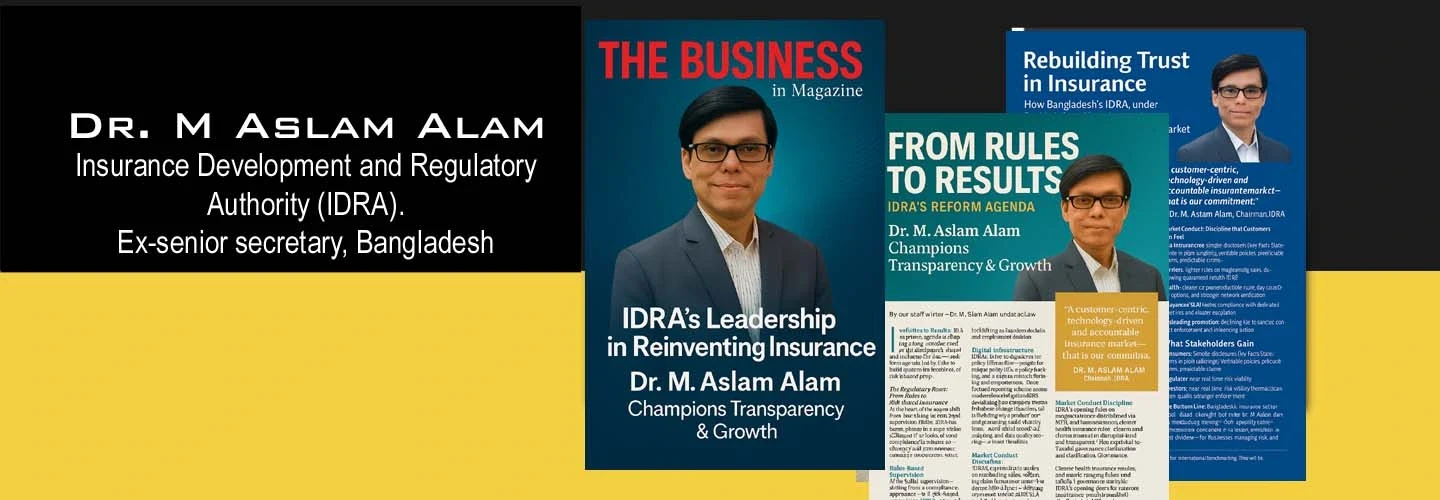
How Bangladesh’s IDRA, under Dr. M. Aslam Alam, is steering a disciplined, digital and inclusive market
Special Correspondent :
29 Oct 2025
Bangladesh’s insurance sector is navigating a long-overdue reset. Following years of slow claim settlements, uneven governance, and fragmented data, a new reform agenda led by Dr. M. Aslam Alam, Chairman of the Insurance Development and Regulatory Authority (IDRA), is reshaping industry behavior. Since taking office on 9 September 2023, Dr. Alam has tied together four decisive strands—risk-based supervision, digital infrastructure, market conduct discipline, and inclusion-led product innovation—with a single goal: rebuild customer trust.
The Regulatory Reset: From Rules to Risk
At the heart of the change is a shift from box-ticking to risk-based supervision (RBS). IDRA has begun phasing in a supervisory scorecard that looks beyond compliance to the real drivers of solvency and consumer outcomes—underwriting quality, reserving, investment risk, liquidity and operations.
Boards are being pushed to work: independent directors, audit and risk committees, and fit-and-proper criteria are no longer formalities but practical guardrails. Related-party transactions face tighter scrutiny, while solvency reporting, reserve adequacy tests, and exposure limits now anchor management decision-making. The effect is cultural as much as technical: risk is becoming a board-level language, not an afterthought.
The Digital Backbone: E-Policy to E-Claim
The second pillar is a data-first market. IDRA’s drive to digitize the policy lifecycle—unique policy IDs, e-policy verification via QR/portal lookup, and e-claim tracking from First Notice of Loss to settlement—does more than modernize the customer journey. It creates verifiable, comparable datasets that regulators and boards can act on.
A new reporting schema (e.g., XBRL/JSON) standardizes how carriers submit policy, premium, lapse, claim, reserve, and investment information. Combined with automated validation and data-quality scoring, it reduces dark corners—errors, inconsistencies and “missing fields” that once obscured the real picture.
Pull-quote: “A customer-centric, technology-driven and accountable insurance market—that is our commitment.” — Dr. M. Aslam Alam, Chairman, IDRA
Market Conduct: Discipline that Customers Can FeelIf regulation and data are the skeleton and nervous system, market conduct is the sector’s public face. IDRA has tightened rules on misleading sales, disallowing guaranteed-return hype or off-book illustrations and mandating pre-approved disclosures.
Most visible to policyholders is a standard on claim turnaround time (TAT): once documents are complete, decisions and payouts should follow within defined windows. A formal grievance-to-escalation SLA moves unresolved complaints from the insurer to the regulator, with repeat offenders facing show-cause notices, monetary penalties, or licensing action. The message is clear: fair conduct is not optional.
Inclusion by Design: Micro, Health, Climate and Takaful
Insurance’s social purpose is getting overdue attention. Under Dr. Alam, IDRA has opened the door to inclusive products at scale:
Microinsurance: low-premium, simple-benefit covers distributed via MFIs and bancassurance to reach first-time customers.
Health: clearer co-pay/deductible rules, day-care/OPD options, and stronger network verification to reduce friction.
Agriculture & Climate Risk:index/parametric pilots that trigger quick payouts after adverse weather events—vital for smallholder resilience.
Takaful (Islamic insurance): clarified Shari’ah governance (board oversight, surplus sharing rules, wakala/mudaraba transparency) to build confidence and participation.
Early Signals: A Before-and-After Snapshot
While official consolidated statistics are still being formalized, directional trends reported across the market suggest tangible improvements:
Claim TAT (Health): moving from slow/uncertain to noticeably quicker, supported by standardized document checklists and e-tracking.
E-policy coverage: rising rapidly as unique IDs and QR verification become the norm.
Grievance SLA: higher compliance with defined timelines and clearer escalation.
Misleading promotion: declining due to stricter conduct enforcement and “mystery-shopping/digital listening.”
Data quality: improved validation rates via structured reporting and API-based submissions.
A small real-world vignette illustrates the shift: a typical networked health claim that once took ~45 days to settle can now close in around ~21 days, given standardized documentation and transparent status updates—less financial stress for families, less noise for carriers.
Data Note: The trends above are indicative and designed for benchmarking discussions; they can be updated as consolidated official figures are released.
Parametric agriculture expansion to additional districts with season-wise coverage.
Mandatory KFS in Bangla & English across product lines—plain-language, one-page truth.
E-claim adoption ≥ 95%, with e-KYC and direct-to-bank payouts.
Thematic audits (commissions, surveyor networks, hospital panels) with concise public notes.
Risks—and Why They’re Being Addressed
Reform is never linear. IT integration and data hygiene vary by carrier; claim-cost inflation can pressure pricing and reserves; and conduct enforcement can meet resistance. IDRA’s approach—sandbox onboarding, targeted capacity-building, periodic pricing/reserving reviews, and structured stakeholder dialogue—seeks to turn these hurdles into milestones.
The Bottom Line
Bangladesh’s insurance sector is not “fixed” overnight. But under Dr. M. Aslam Alam, it is measurably moving—from opacity to traceability, from promises to performance, from exclusion to inclusion. If momentum holds, the payoff will be more than regulatory compliance; it will be a trust dividend—for households seeking security, for businesses managing risk, and for an economy that needs deeper, more credible financial shock-absorbers.
Senior Secretary M Aslam Alam
The government has appointed former senior secretary M Aslam Alam as the new chairman of the Insurance Development and Regulatory Authority (IDRA).
The Ministry of Finance issued a circular in this regard on Monday.
Aslam has been appointed on a contractual basis for a three-year term or until he turns 68 years old.
The post of IDRA’s Chairman became vacant following Mohammad Jainul Bari’s resignation as chairman of the insurance regulator on September 5.
Bari was made chairman of the insurance regulator in June of 2022 for a three-year term. M Aslam Alam is the 10th chairman of the IDRA.
Editor’s note: Certain metrics are presented as directional trends suitable for international benchmarking. They will be refreshed as IDRA and industry participants publish consolidated figures.