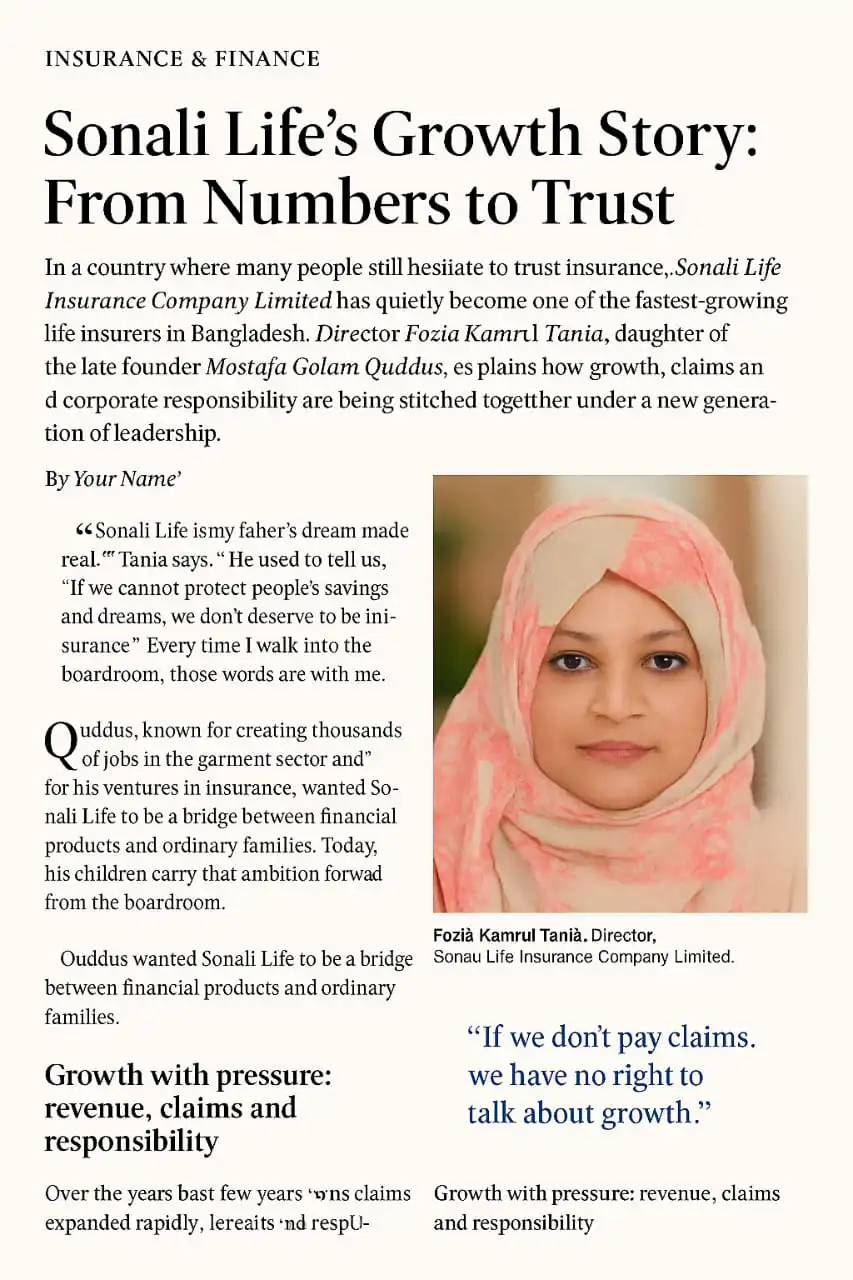
> “Sonali Life is my father’s dream made real,” Tania says. “He used to tell us, ‘If we cannot protect people’s savings and dreams, we don’t deserve to be in insurance.’ Every time I walk into the boardroom, those words are with me.”
 Over the last few years, Sonali Life’s business has expanded rapidly. Premium income and customer numbers have risen sharply, and the company now has a strong footprint across the country.
> “We can’t celebrate revenue unless we are equally serious about claims,” she says. “For me, real growth means our claim payments are rising along with our premium income. It means people trusted us in some of the hardest moments of their lives — and we did not let them down.”
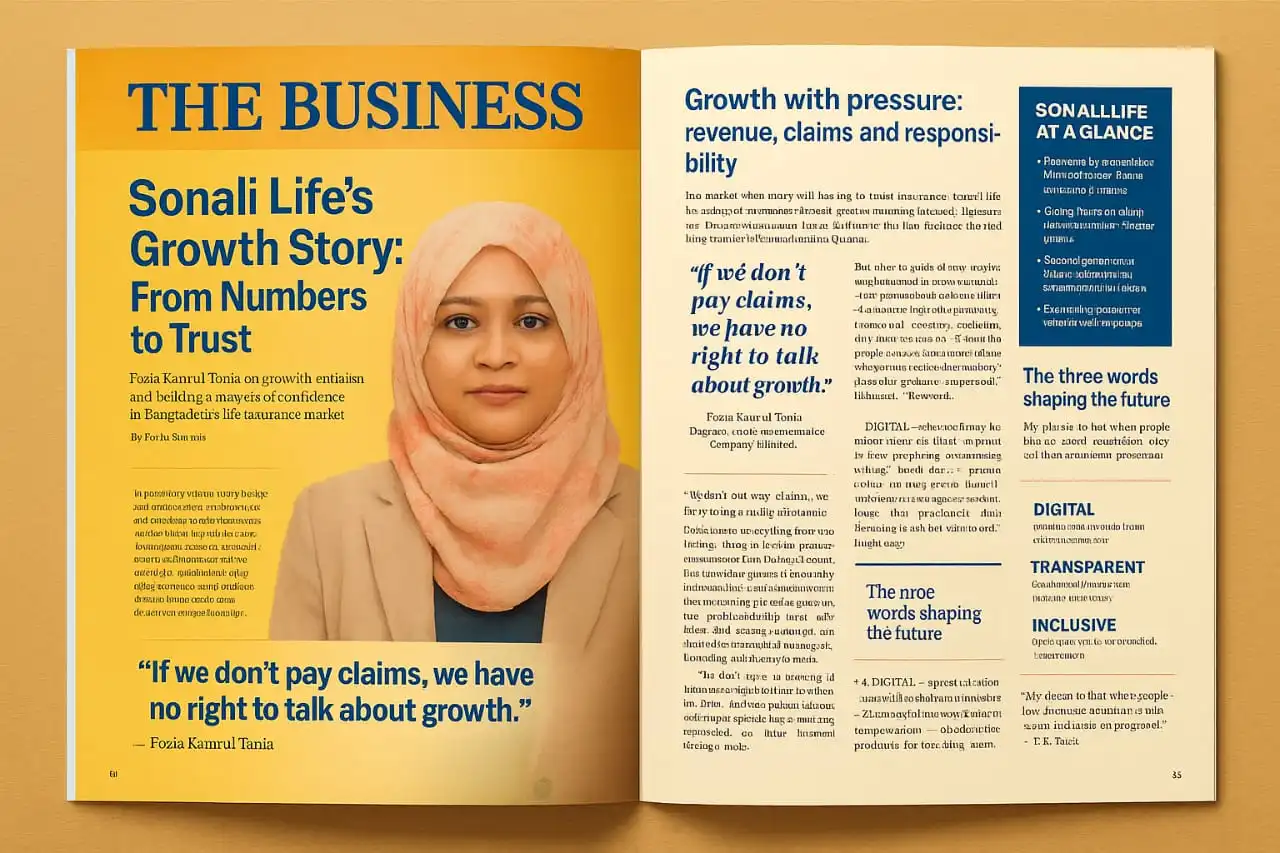
> “If we don’t pay claims, we have no right to talk about growth.”
 This rule shapes everything from training field staff to simplifying documentation for beneficiaries in remote villages. Farmers, garments workers and migrant workers’ families are among those who depend on timely claim payments.
> “When a widow tells us, ‘Because of your claim payment I could keep my children in school,’ that is when all the spreadsheets on my desk make sense,” Tania says. “Those are the moments that define what kind of insurer we really are.
> “I will never say there are no questions about us,” she admits. “Yes, there have been criticisms and cases. Large institutions always face pressure. What matters is how we respond.”
> “We are using this period to strengthen our governance,” she explains. “We are tightening internal controls, improving audit and compliance, and making our reporting structures more robust. Criticism is not the final word — the final word is what we learn from it and how we change.”
> “We don’t look at Sonali Life as a short-term opportunity,” she says. “We are emotionally tied to this name because it carries our father’s legacy. That forces us to think long term. We cannot simply exit if things get difficult.”
> “We rely on experienced actuaries, finance professionals, risk managers and marketers,” she explains. “The formula we believe in is simple:Family legacy plus professional management equals sustainable growth.”
> “Awards are an honour,” Tania says. “They tell us we are moving in the right direction. But I always tell my team: ‘Awards come from institutions; real rewards come from people.’”
> “When a family in a small town says, ‘We actually received our claim from Sonali Life,’ that matters more than a stage photo,” she says. “It means we were present when they needed us, not just in our advertisements.”
> “We want people to be able to buy policies, pay premiums, file claims and track everything from their phones,” she says. “Convenience builds trust.”
> “Customers deserve to know, in clear language, where their money goes and how we protect it,” she adds. “Transparency is not a luxury in insurance; it is the foundation of trust.”
> “Low-income workers, informal sector earners, rural families — they carry the highest risks but have the least coverage,” Tania says. “We want to design products that truly reach them, not just look good in brochures.”
> “My father wanted ordinary Bangladeshis to believe in insurance again,” she says. “My dream is that when people hear the name Sonali Life, they feel their dreams are protected. We will make mistakes, I’m sure. But we will keep learning, correcting and moving forward. That is my promise.”
Author Profile: Ali Kodar Polash (আলী কদর পলাশ) is a distinguished journalist, editor, and publisher with over three decades of experience in Bangladesh’s newspaper industry. He began his editorial and publishing journey in 1991 by founding the daily newspaper Dainik Mathabhanga in Chuadanga.
On January 1, 1992, he established Ei Amar Desh, which has since evolved from a weekly into a widely recognized daily newspaper. He is also the founder of Dainik Jhenaidah, the first daily newspaper of Jhenaidah district, launched on April 14, 1993, as well as Dainik Adhibeshon.
Currently, he serves as the Chief Editor and CEO of Dainik Mukhaptra, a publication of Diamond World Group. In addition, he contributes to modern journalism and economic analysis through his digital platform The Business In.
His writing is deeply rooted in grassroots journalism, enriched by decades of hands-on experience, which remains the defining strength of his editorial voice.

- admin1@gmail.comhttps://thebusinessin.com/author/admin1gmail-com/

- admin1@gmail.comhttps://thebusinessin.com/author/admin1gmail-com/

- admin1@gmail.comhttps://thebusinessin.com/author/admin1gmail-com/

- admin1@gmail.comhttps://thebusinessin.com/author/admin1gmail-com/